



Having a child with a food allergy can be a nightmare for parents. Peanut allergies are especially tricky because not only are peanuts in many foods, they're present in facilities that process foods. This can lead to risky, unexpected exposures.
The health risks of peanut allergies led the National Institute of Allergy and Infectious Diseases to issue guidelines in 2017 for introducing babies to peanuts early in life.
The goal of the guidelines, which were also endorsed by the American Academy of Pediatrics, was to prevent kids from developing peanut allergies in the first place by giving babies small tastes of peanuts a few times a week starting at four to six months of age for the first year of life, if not longer.
The guidelines are having the intended effect: rates of peanut allergy are decreasing, but a new study from researchers at Northwestern University suggests parents may need education and support from their pediatricians to introduce their babies to peanuts the right way, Waheeda Samady, its lead author, said.If parents of babies with eczema understood that the worse a baby's eczema is, the greater the risk of developing a food allergy, they would be more likely to start peanut introduction early to prevent peanut allergy.
The researchers analyzed responses from 49 interviews with parents of infants between eight and 13 months old who lived in the Chicago area. The families came from diverse socioeconomic backgrounds and were recruited from academic and private clinics and federally qualified health centers.
Samady found it interesting to see how information about peanut introduction was being received by families. Most parents said they were aware of these guidelines and thought the recommendations made sense. The researchers noticed a few things, however, when they went over their responses.
“People understood the concept of giving their baby peanuts and would give them for the most part, but it was all over the place in terms of how much, how often and how long peanuts stayed in the diet,” Samady said.
Some parents thought giving their baby peanuts was like getting them a flu shot. They felt that exposing babies to peanuts helps prevent allergies because it teaches their immune system to recognize peanuts as food, not an allergen. “I thought that was a very intelligent way of looking at it,” said Samady, a pediatrician at the Ann and Robert H. Lurie Children's Hospital of Chicago.
Other parents thought the purpose of giving their baby peanuts was to see if the baby already had an allergy. This misconception can make parents delay peanut introduction for fear of an allergic reaction. It also determined how they exposed their baby to peanuts. Those that thought giving babies peanuts was an allergy test only gave them peanuts one or twice to see if their baby had a reaction.
Most parents were unaware of the association between eczema and food allergies. The worse a baby's eczema is, the greater the risk of developing a food allergy. The researchers think if parents of babies with eczema were aware of this association, they would be motivated to start peanut introduction as early as four months of age to prevent peanut allergy.
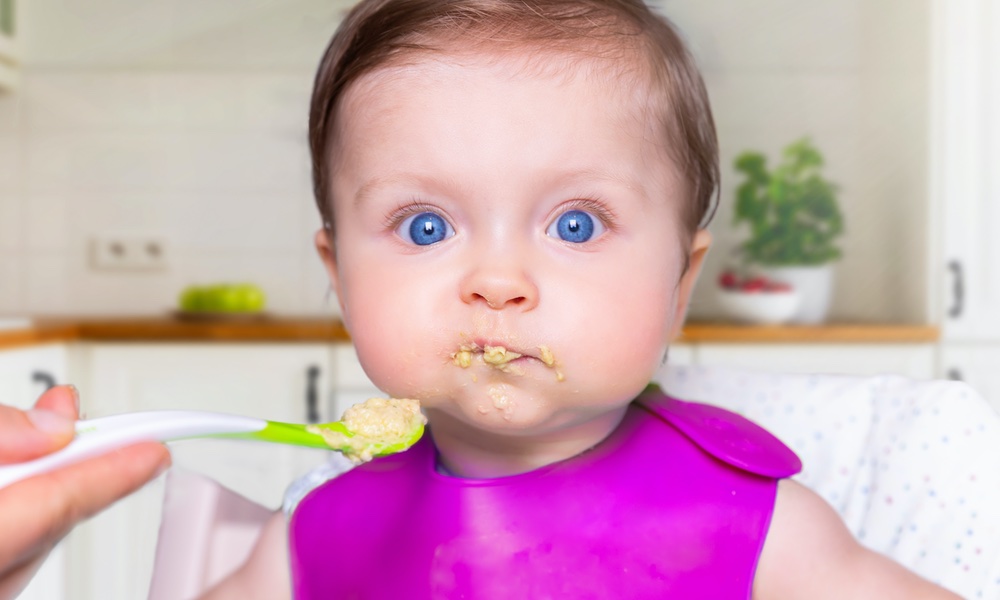
Peanut butter is what most parents use to introduce babies to peanuts. Parents or caregivers can thin it out with water or breast milk, or make a puree with apple sauce or oatmeal, Samady said. A four- or five-month-old can only eat a tablespoon or two of food at a time, so adults can put a teaspoon or two of peanut butter into a tablespoon or two of whatever they decide to mix it in with two or three times a week.Parents can put a teaspoon or two of peanut butter into a tablespoon or two of puree or breastmilk or whatever they decide to mix it in with two or three times a week.
“Having trusted resources that cover this information is really important,” Samady, an associate professor of pediatrics at Northwestern University Feinberg School of Medicine, emphasized. The problem is that pediatricians have about 10 topics to cover in only 15 or 20 minutes, when babies come in for the four- to six-month checkups, she explained. As a result, the introduction of solid foods, including peanuts, often gets little discussion compared to topics like sleep and development.
Parents wanting more information should look at the basic information sheet on children's food allergies produced by the Ann and Robert H. Lurie Children's Hospital.
The study is published in JAMA Network Open.