
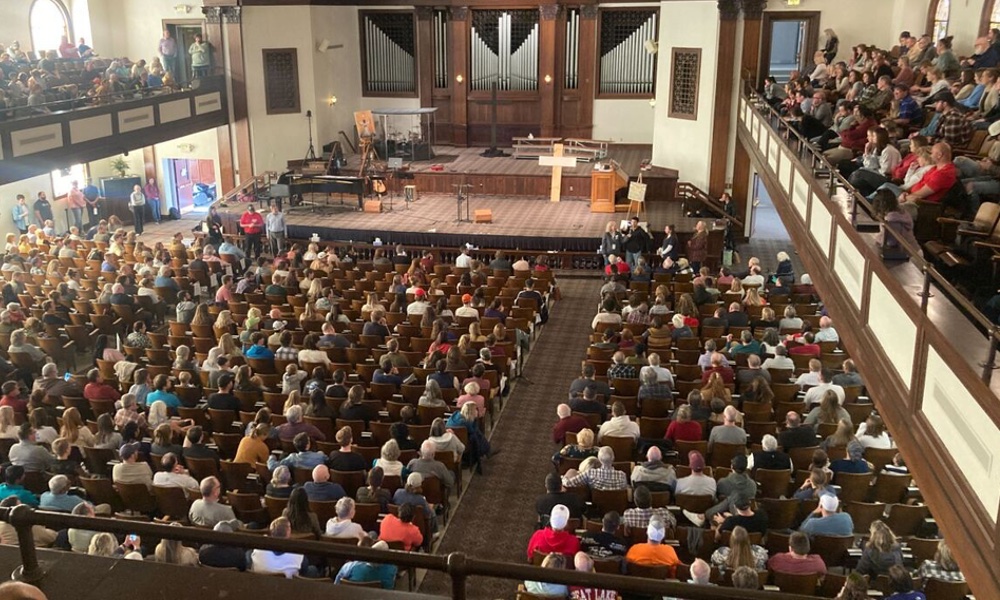


Politics may be playing a larger role in evangelical churches that many Americans realize, according to a sweeping new study published in the Proceedings of the National Academy of Sciences. When the researchers analyzed more than 88,000 sermons delivered during recent election cycles, they found that direct political advocacy from the pulpit was both widespread and strategically timed around major elections.
They examined sermons from predominantly evangelical churches across the United States, representing more than 63,000 hours of recorded Sunday services during the 2020, 2022 and 2024 election cycles, as well as non-election periods for comparison.
The study's goal was to better understand how frequently churches engage in political speech, particularly that which could violate the Johnson Amendment, a federal law that prohibits tax-exempt nonprofit organizations, including churches, from endorsing or opposing political candidates.The Johnson Amendment is a federal law that prohibits tax-exempt nonprofit organizations, including churches, from endorsing or opposing political candidates.
The researchers found that nearly 15 percent of the churches included in the analysis engaged in direct political advocacy during the three months surrounding the 2024 presidential election. Political activity reached its peak on the Sunday immediately before Election Day, when 3.5 percent of the churches studied engaged in voter mobilization efforts.
Swing states and battleground regions were not the only places where this occurred. Instead, the researchers report that rates of political advocacy closely mirrored the partisan makeup of local counties, suggesting that local political culture may influence church messaging more than national campaign strategy.Evangelical churches may be especially influential because many operate without centralized oversight, giving pastors broad discretion over sermon content and church activities.
“Our results provide large-scale qualification of political speech from American pulpits that constitutes prohibited electioneering under current Internal Revenue Service (IRS) guidelines,” the researchers write. For many Americans, the findings may raise questions about the changing relationship between religion and politics.
The team notes that evangelical churches may be especially influential because many operate independently without centralized oversight. This structure gives pastors broad discretion over sermon content and church activities.
The study also points to a longstanding lack of enforcement of the Johnson Amendment. Some pastors have openly challenged the law through organized events such as “Pulpit Freedom Sunday,” during which clergy intentionally endorse candidates and send recordings of their sermons to the IRS in protest.
Despite those public challenges, enforcement actions have been rare. According to the authors, no participating church has lost its tax-exempt status as a result of involvement in those campaigns. The researchers suggest that this absence of enforcement may have helped create over time what they describe as a “permission structure,” encouraging greater political activity from the pulpit.
The study relied on computational methods rather than anecdotal reports. Researchers were able to measure political patterns on a national scale that would have been nearly impossible to document manually by analyzing tens of thousands of sermon transcripts.