
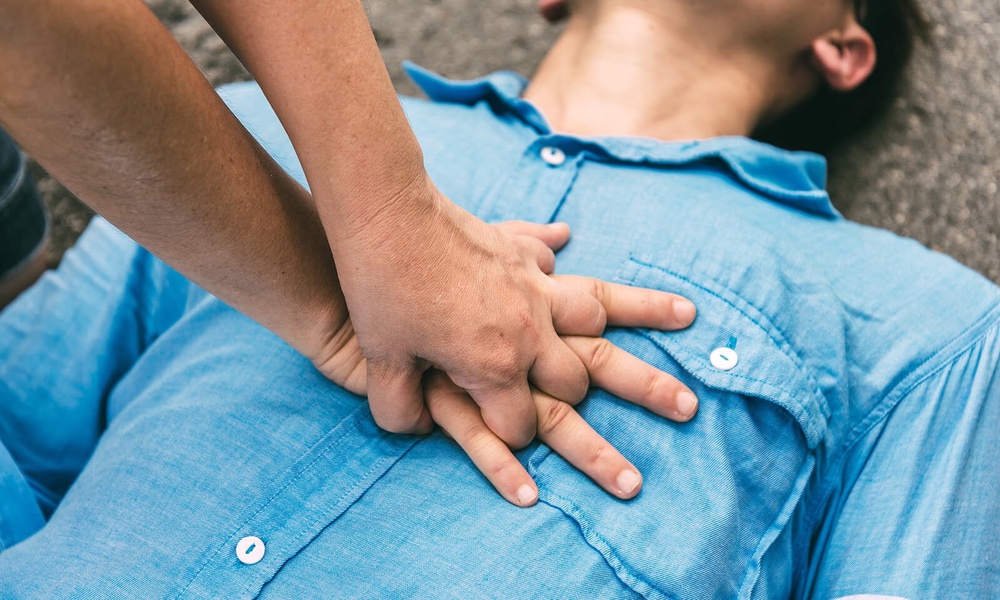


About 350,000 Americans experience cardiac arrest every year outside of a hospital. Fewer than half of them, 41.7 percent, receive CPR — cardiopulmonary resuscitation — at the scene from a bystander.
The time between a 911 call and the start of chest compressions by a bystander is almost three minutes. Artificial intelligence (AI) may be able to offer bystanders the additional support they need to take action while paramedics are on the way.
In fact, an AI-powered CPR coach outperformed 911 dispatchers in guiding bystanders through CPR. The AI coach was trained on 911-dispatcher training materials and CPR best practices and was developed by a team led by researchers at the University of California, San Diego.
“If AI is going to earn its place in medicine, it should start by helping people save the person in front of them,” John Ayers, a coauthor on the study, told TheDoctor.Only two percent of people in the U.S. are CPR certified. One of the barriers to becoming CPR certified is having access to realistic training.
The researchers used six popular AI models for the initial study: Claude, ChatGPT, Gemini, Llama, Mixtral and Grok. They challenged each model with simulated emergencies, such as drowning or collapsing while jogging. The models did well at providing CPR instruction across a wide age range of “victims,” from toddlers to older adults. The AI assistants' instruction scored an average of 90 percent on CPR basics, such as where and how fast to press on the patient's chest. Scores ranged from 79 percent (Gemini) to 97 percent (Grok and Claude).
Scores dropped, however, when the AI models gave instructions that would lead to the best possible chance of survival. For these advanced instructions, such as letting the chest rise fully between compressions, the average score was 70 percent, and scores ranged from 61 percent (Llama) to 75 percent (ChatGPT).
“In cardiac arrest, good is not good enough,” Cameron Dezfulian, a coauthor on the study and a senior faculty member at the Baylor College of Medicine, said in a statement. “Missing 10 percent to 30 percent of steps can mean the difference between life and death.”
The performance gaps between basic and advanced CPR instruction informed the second aspect of the research — the development of ChatCPR. The model was based on 911-dispatcher training materials and CPR best practices. In the same basic and advanced scenarios used to test the AI models, ChatCPR scored 100 percent.
To see if ChatCPR would work in real life, the researchers used a set of real 911 calls that had been de-identified. The dispatchers on these calls had already provided CPR instructions. When the researchers compared these instructions to those provided by ChatCPR, they found the dispatchers met 85 percent of basic CPR instructions and ChatCPR met 100 percent. ChatCPR met 99 percent of more advanced instructions and the dispatchers met 63 percent.
“ChatCPR excelled in areas where stressed, multitasking dispatchers often faltered,” Nimit Desai, lead author of the study and a medical student at the UC San Diego School of Medicine, said in a statement.
The researchers made ChatCPR publicly available and free for anyone to use. The public can access it to help improve survival rates for out of hospital cardiac arrests. “Access to CPR should not be a luxury, but unfortunately, it still is,” Ayers said. ChatCPR could even eventually be available on smartphones. This would mean that, “People could have a CPR coach in their pocket at all times,” said Ayers, a professor of medicine at UC San Diego School of Medicine and head of AI at the UC San Diego Altman Clinical and Translational Research Institute.
Only two percent of people in the U.S. are CPR certified. One of the barriers to becoming CPR certified is having access to training. And training can be unrealistic: trainees practice on a dummy and are often given unrealistic emergency situations. ChatCPR helps people learn CPR in realistic simulations of out of hospital cardiac arrests, though the researchers acknowledge that more testing of ChatCPR is needed to make sure it offers safe and accurate instruction, works in often chaotic emergencies and is easy for users to follow.ChatCPR, a model based on 911-dispatcher training materials and CPR best practices, teaches people CPR using realistic simulations of out-of-hospital cardiac arrests.
The study and a related editorial are published in JAMA Internal Medicine.