
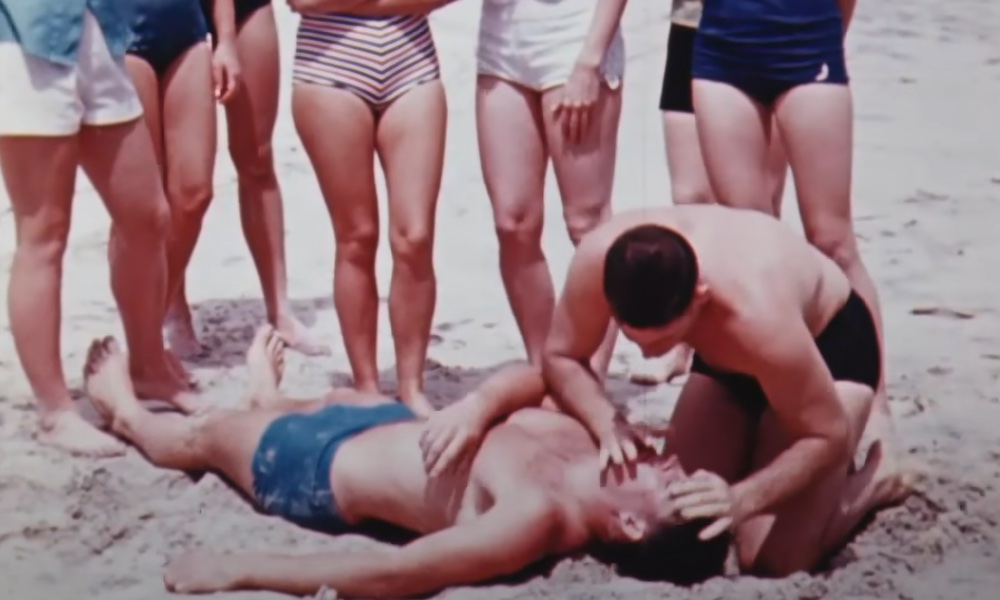


If you've ever watched someone collapse on a television show, you already know what happens next. A frantic bystander drops to the floor, tilts the person's head back, puts their mouth over the victim's and then checks for a pulse before pushing on their chest. It looks dramatic and medically sound. But according to research, it's often wrong.
Perhaps inspired by the television hit set in their hometown, “The Pitt,” researchers at the University of Pittsburgh School of Public Health and School of Medicine have published the first comprehensive analysis of how bystander CPR is portrayed on scripted American television shows.
You can learn CPR — cardio-pulmonary resuscitation — in classes or even at the airport, but for many people, the main exposure comes from a screen.Hands-only CPR has just two steps: call 911 and start chest compressions. No mouth-to-mouth. No pulse-check. Just push hard and fast in the center of the chest until help arrives.
Hands-only CPR has just two steps: call 911 and start chest compressions. No mouth-to-mouth. No pulse-check. Just push hard and fast in the center of the chest until help arrives.
Yet when the researchers analyzed 169 U.S. television episodes that depicted cardiac arrest and CPR since the AHA change, fewer than 30 percent showed the correct steps. Nearly half of the episodes still televised mouth-to-mouth resuscitation, and 43 percent included a pulse check — both outdated practices for lay rescuers.
“In my volunteer work training Pittsburgh youth in CPR, there's a lot of confusion,” Beth Hoffman, PhD, MPH, assistant professor of behavioral and community health sciences at the University of Pittsburgh School of Public Health, said in a press release. “We ask students, ‘What's the first thing you do?' and they say ‘Check for a pulse.' But we don't do that bystander CPR anymore.” She added, “And in our pre-course surveys a lot of students say that they've seen CPR on social media and television. Those two observations inspired the study.”
To see what viewers were really being taught, the team searched the Internet Movie Database (IMDb) using CPR-related keywords and reviewed every eligible scripted TV episode released after 2008. Each episode was watched and double-coded by trained research assistants using a standardized approach.
Television also gets who needs CPR and where, badly wrong. On screen, 44 percent of CPR recipients were between 21 and 40 years old. In real life, the average age of someone who receives CPR is about 62. TV also suggests cardiac arrests mostly happen in public places — on the street, in a restaurant or at work. In reality, about 80 percent of out-of-hospital cardiac arrests happen at home.
Television does accurately mirror real-world disparities in who receives CPR. Most characters shown getting hands-only CPR were white men; and in real life, women and Black and Latino people are less likely than white men to receive bystander CPR. “Whether this is reflecting reality or whether it's shaping reality, we don't know, but that would be a good question to explore in future studies,” Hoffman said.Bystander CPR can double or even triple a person's chance of survival. In that context, television's mixed messages are not just a harmless plot device.
She believes partnerships between public health experts and television creators could make a difference helping scriptwriters depict CPR in ways that empower viewers to act and act correctly when seconds count.
TV dramas may be scripted but cardiac arrest is not. If someone collapses on the playing field or in your living room, knowing that you need to call 911 and start chest compressions could save a life.
The research letter is published in Circulation: Population and Health Outcomes.