

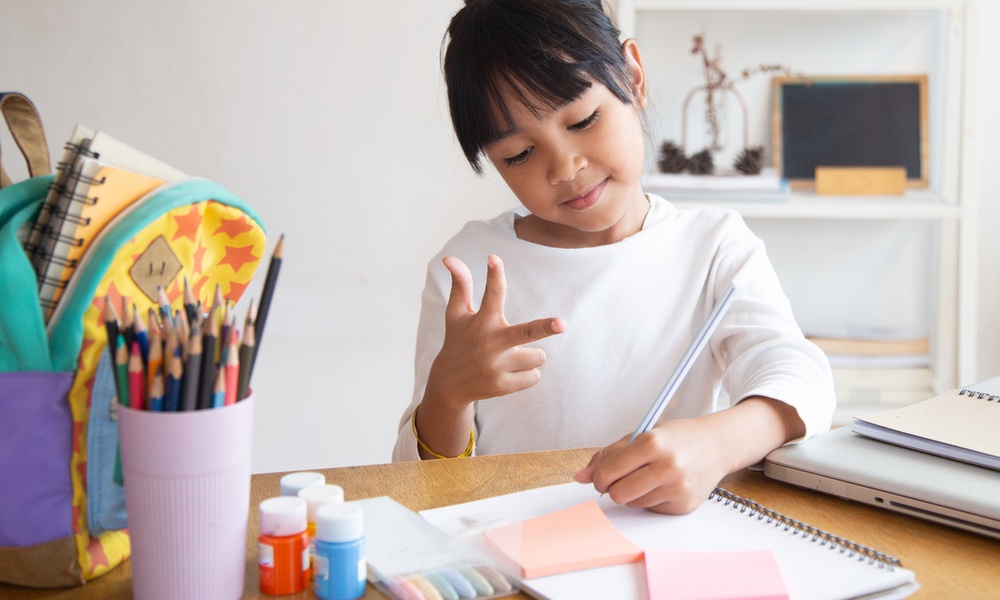


For many young children, fingers are their first calculator. Ask a preschooler what 4 plus 2 equals, and chances are they'll lift their hands and start counting. While some adults see this as a habit kids should quicky outgrow, new research shows that finger counting isn't a crutch at all. It's a powerful early tool that can pave the way towards stronger math skills.
Researchers followed over 200 Swiss children from ages 4½ to 7½, roughly preschool to second grade, to explore how their use of finger-counting strategies evolved over time and how that evolution shaped their addition skills.
Until now, most research focused on children's finger counting at only one point in time, making it hard to know whether kids who stop finger counting are simply more “advanced” from the start or whether using fingers early on is part of what builds more advanced arithmetic skills later in life. The idea behind a new study was to explore that missing piece.
It turns out counting on fingers is more than just a beginner's strategy. “Finger counting is not just a tool for immediate success in young children, but a way to support the development of advanced abstract arithmetic skills,” lead author Catherine Thevenot, a specialist in development and cognitive psychology at the University of Lausanne, said in a media release.By literally “handling” numbers in early childhood, kids lay the groundwork for more abstract reasoning later in their lives.
To explore what the developmental arc of finger counting might be, the team of Swiss researchers at the University of Lausanne tested children twice a year, videotaping them as they solved addition problems that gradually increased in difficulty. Children started with simple sums involving numbers between 1 and 5, moved on to problems mixing small and larger numbers, and finally attempted sums involving two digits between 6 and 9. They progressed only when they correctly answered at least 80 percent of the problems in a set. This design insured accuracy before advancement.
What emerged was a detailed picture of children transitioning through finger-counting phases. Finger use peaked between ages 5½ and six years, which aligns with what many teachers intuitively observe. But the breakdown at age 7½ was especially revealing: 50 percent of children were still finger counters, 43 percent had used their fingers in the past but no longer did (labeled “ex-finger counters”), and only 7 percent had never used their fingers at all.
Performance differences among these groups were unmistakable; beginning around age 6, children who used to rely on their fingers, but had since transitioned to mental strategies, consistently outperformed both those who still counted on their fingers and those who never had. The lowest performing group, however, consisted of the 12 children who had never used finger counting across all assessments. Meanwhile, late starters — children who began using their fingers later and continued to rely on them past age 6½ — did not achieve the same level of proficiency as the former finger counters.
These findings help explain a long-standing puzzle in earlier studies. Why do finger counters outperform non-finger counters until age seven, but then fall behind afterward? What matters isn't whether a child counts on their fingers at age seven, Thevenot and her colleagues found, it's whether they once did and eventually moved on. In other words, finger counting is a developmentally important stepping stone rather than a sign of a struggle.Preventing children from using their fingers may deprive them of a natural, embodied learning tool that supports both memory and conceptual understanding.
This insight has direct implications for parents and teachers. Despite widespread beliefs, research shows nearly a third of first-grade teachers interpret finger counting as a sign of difficulty. This study suggests the opposite: Preventing children from using their fingers may deprive them of a natural, embodied learning tool that supports both memory and conceptual understanding.
“This research supports encouraging children to use their fingers in arithmetic without fear that they will become stuck in limited strategies,” said Thevenot.
The study also reinforces earlier findings from psychology and neuroscience showing that finger movements activate brain regions involved in numerical processing. By literally “handling” numbers in early childhood, kids lay the groundwork for more abstract reasoning later in their lives.
Young children don't cling to finger calculations forever. They let go when they're ready. And those who have used them thoughtfully along the way may be better equipped to soar in math as they grow. Finger counting, it appears, isn't a detour. It's a journey on the main road.
The study is published in the Journal of Experimental Child Psychology.