



What do the following groups of people have in common: residents of the island of Okinawa in Japan; Sardinians from Italy; and Seventh Day Adventists in Loma Linda, California? Though they may seem incredibly different, these populations all have life-spans that are considered by experts to be exceptionally long (in some cases, individuals can live to be over 100 years old) compared to most others around the world.
Studying the lives of humans around the world, as well as other species who have varying life spans, helps scientists understand the underlying mechanisms of aging: how it works on a cellular level, why it occurs at all, and what we can do to live healthier and longer lives.
What makes these groups so special and what can we learn from centenarians (people who live into their hundreds) about the aging process? Is it their genes, diets, other lifestyle factors, or is it simply luck – that is, have they been able to somehow dodge the diseases that others have fallen victim to along the way? The answer seems to be a little bit of all the above.
Researchers are very interested in learning from centenarians about what they’re doing right – or what they have done right for the preceding century. Studying the lives of humans around the world, as well as other species who have varying life spans, helps scientists understand the underlying mechanisms of aging: how it works on a cellular level, why it occurs at all, and what we can do to live healthier and longer lives.
In multicellular organisms, like humans, senescence is thought to occur in species where the germ cell line is separate from the body cell lines and in those who give birth to separate (and smaller) offspring or, more specifically, in animals whose body cells differentiate and serve separate functions.
Senescence typically falls into one of three categories, depending on the kind of animal we’re talking about: it can be rapid, gradual or negligible. In certain animals like roundworms and flies, rapid senescence occurs suddenly, with deteriorative changes happening soon after the animal has matured; in others organisms, like annual plants and Pacific salmon, it occurs just after the animal reproduces. Negligible senescence occurs in long-lived species like clams, trees, fish and reptiles. In these types of organisms, mortality rates don’t seem to increase after the animal is mature. Humans, like all other animals with placentas, experience gradual senescence. This form progresses slowly but persistently after the animals is mature.Humans, like all other animals with placentas, experience gradual senescence. This form progresses slowly but persistently after the animals is mature.
The researchers estimated that over the course of human history, the odds of a woman living from birth to age 100 has risen from 1 in 20 million to 1 in 50 in countries like Japan and Sweden, which are considered to be “low mortality” nations.
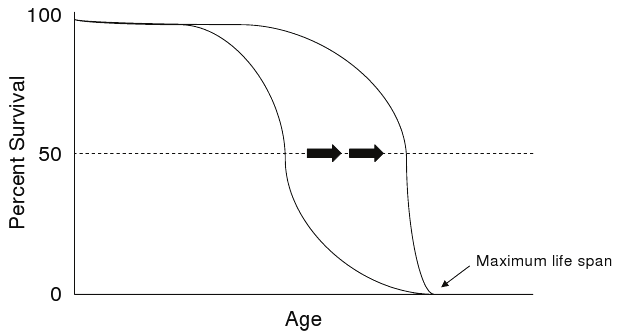
Median life span, the age at which there are as many individuals with shorter life spans as there are individuals with longer life spans, and life expectancy are increasing in many populations across the globe. What factors are behind these increases? An important trend is that the number of premature deaths has decreased in recent years, which probably plays a bigger role in longevity than any significant changes to the aging process itself. (Figure 1). Over the last century, there has been a huge decrease in the infant death rate. This has been is due to a number of factors, such as improvements in sanitation, nutrition, and immunization.
Click image for larger view.
Increase in average life span (block arrows), but not maximum life span, is the result of protection from premature death.
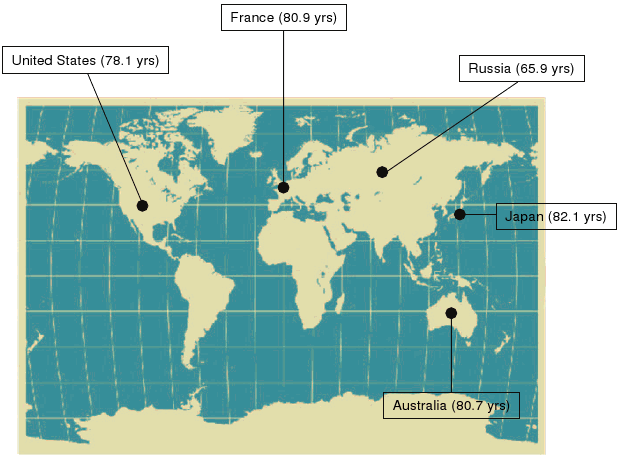
Median life span and life expectancy are therefore influenced by many factors and are probably not related to primary aging processes. However, in 2008, life expectancy at birth exceeded 80 years in 11 countries around the world. Even more astounding is that in the twentieth century, life expectancy doubled in some developed countries. Although rising life expectancy at birth is not a universal phenomenon, the highest recorded average life expectancy is for Japan, where it continues to rise. In fact, female life expectancy in Japan has risen steadily for the last 160 years at rate of almost 3 months/year. Figure 2 illustrates the average life expectancy in selected developed countries.
Click image for larger view.
Life expectancy at birth in 2008 in five developed countries. Source: U.S. Census Bureau, International Database, assessed on May 27, 2008.
That brings us back to centenarians and what their successful aging may tell us about the primary aging processes. One study found that the number of people over one hundred doubled each decade between 1950 and 1990. According to this study, there may be some differences between the sexes in terms of how we age. The researchers estimated that over the course of human history, the odds of a woman living from birth to age 100 has risen from 1 in 20 million to 1 in 50 in countries like Japan and Sweden, which are considered to be “low mortality” nations. About one in every 10,000 people in the United States is at least 100 years old. It is likely that most industrialized countries will soon see similar increases in the number of centenarians, if they have not already.
The maximum human life span is more than 115 years. The oldest recorded ages have been for Jeanne Calment who died at age 121 in France in 1996 and Antonio Todde who died in Sardinia (Italy) in 2002, just two weeks before his 113th birthday. An interesting phenomenon is that although the median length of life and life expectancy for humans have increased greatly over the last 100 years, there has been little, if any, change in the maximum life span. In fact, over long periods of history the maximum human life span has been fairly stable.
Certain populations of people around the world, like the ones mentioned in the opening of the article, seem to have a leg up on living a long time. Is it just genetics? Researchers have found there seems to be a wide variety of factors behind the longevity of various groups of people.
The long-lived Okinawans live by the dietary mantra, 'hara haci bu,' or 'eat until you are only 80% full.'
The fact that this population tends to have lower BMIs suggests that a modest caloric restriction may be at least partly responsible for their long life spans. More evidence for this idea comes from a recent study of U.S. centenarians born in the 1880s, which found that lean body mass was also associated with extreme longevity. Okinawans also have a slower natural decline of the adrenal hormone dehydroepiandrosterone (DHEA), which is considered a fairly good marker of life span extension; a similar decline in DHEA is also seen in experiments with animals who are put on restricted calorie diets.
True biomarkers of aging, if identified, would help doctors determine a person’s “real” or biological age, and therefore be able to estimate one’s life expectancy. Reliable biomarkers would also make tracking the roles of different factors or “interventions” on the aging process much easier. To be effective, a biomarker of aging would have to include several features. First, a strong, measurable relationship between the biomarker and the age of the population would have to be demonstrated. Second, the biomarker would have to be unaffected by the presence of disease. Third, confidence that an age-related alteration in the parameter is not secondary to metabolic or nutritional changes. (For example, someone who is malnourished can be susceptible to disease and die—this has nothing to do with aging. So a biomarker that changes with nutritional changes is really not a good biomarker for aging.) And finally, factors that influence the rate at which people age would likewise affect the particular biomarker.
Although mortality rates for many diseases increase with age, at least one estimate predicts that eliminating heart disease and cancer as causes of death would only add about ten years to the average life span and would probably not affect maximum life span at all.
What actually happens to people as they age? Aside from the obvious increase in mortality rate, which we’ve already discussed, there are some biological changes that are pretty much inevitable as we get older. One is changes to the tissues of the body (seen in the development of wrinkles), which comes from modifications in their biochemical make-up (such as shifts in the structure of collagen, as well as increases in lipofuscin a.k.a the “age pigment,”). Other age-related changes include things like decline in kidney function, the maximum rate at which they heart can pump blood during exercise, and changes in the way the liver metabolizes medications. As a person ages, there is also, of course, an increased risk of developing certain diseases like heart disease, type II diabetes, osteoporosis, and Alzheimer's disease.
In centenarians, the age that one is typically struck with common age-related diseases (not including cognitive impairment) was found to vary , with 24% of males and 43% of females attaining at least one diagnosis prior to the age of 80. About 43% of all centenarians experienced delayed onset of age-related disease until they were at least 80 years old. Approximately 30% of male centenarians and 15% of female centenarians escaped any diagnosis by age 100. This suggests that the onset of age-related problems, for both men and women, is fairly variable – but earlier onset of these conditions (prior to the age of 80) does not prevent people from living exceptionally long lives.
As many as 25% of centenarians have normal cognitive function. Among centenarians who do develop cognitive problems, the vast majority of don’t develop problems until they are about 92 on average. There are centenarians who demonstrate no evidence of neurodegenerative disease, and there are some who, despite having some of the markers of Alzheimer’s disease, do not actually meet the criteria for dementia.
One theory, called “compression of morbidity,” tries to explain how just how people with exceptional longevity live longer than regular folk. If people live longer, they would have lower morbidity by “compressing” the number of years they would suffer from chronic diseases and associated disability.
As many as 25% of centenarians have normal cognitive function...There are centenarians who demonstrate no evidence of neurodegenerative disease, and there are some who, despite having some of the markers of Alzheimer’s disease, do not actually meet the criteria for dementia.
There’s actually some evidence to support this hypothesis. Disability has been declining by about 2% per year, and mortality has declined by 1% per year during this same period. With the fastest growing segment of the American population being 85 years and older, however, there is some concern that “compression of morbidity” (and disability) might not hold true for those who survive to exceptional old age. Delaying serious health problems from age-onset diseases occurs in many of those who survive to very old age; for others who survive to extreme old age, delays in disabilities alone seem to be the important factor.
As mentioned, one component of longevity seems to be purely genetic. This idea is supported by the fact that within a species, life span is fairly consistent, and by the fact that identical twins tend to live to more similar ages than do fraternal twins or non-twin siblings. Likewise, exceptional longevity seems to be a trait that runs within families. Twin studies have shown us that genetic differences likely account for about 25% of the variation in adult human life span. The children of centenarians have increased odds of surviving to 100 years and like their parents have a reduced risk for age-related diseases. Compared to others who lived at the same time and in the same place as the ancestors of Jeanne Calment, she had an extraordinary group of long-lived relatives within her family’s last five generations. This was particularly true of her father’s side of the family, which suggests that she must have inherited some part of her longevity from her (paternal) genes. Other research has shown certain genes and pathways (like the apolipoprotein E gene, insulin/insulin-like growth factor-1, and anti-inflammatory cytokines) have also been linked to the aging process.
For more information, the GenAge database (http://genomics.senescence.info/genes/) gives a complete listing of genes analyzed for their possible association with human longevity http://genomics.senescence.info/genes/longevity.html).
Much of the evidence for the evolutionary theory of aging comes from studies of flies and “lower” mammals. In these cases, extended life spans have been brought about by reduced pressure for early reproduction either intentionally (by experimenters in the case of the fly) or naturally (in the case of certain mammals). Similarly, the incredibly long lives of birds and turtles, compared to mammals, is thought to be related to genes that favor reproduction later in life, regardless of whether the animals have many predators or not.
There may be similar evolutionary explanations for humans’ increasing life spans. Some researchers feel that our longer lives may be linked to the increasingly longer periods that women are able to have children. The length of a woman’s post-reproductive life span is mirrored in the reproductive “success” of her own children – and in the survival of her grandchildren, a phenomenon that is known as the “grandmother hypothesis”, and may be more relevant in the case of maternal grandmothers. In a study of centenaries who lived in the U.S in the 1980s, large numbers of children, but not martial status, was associated with long life spans.
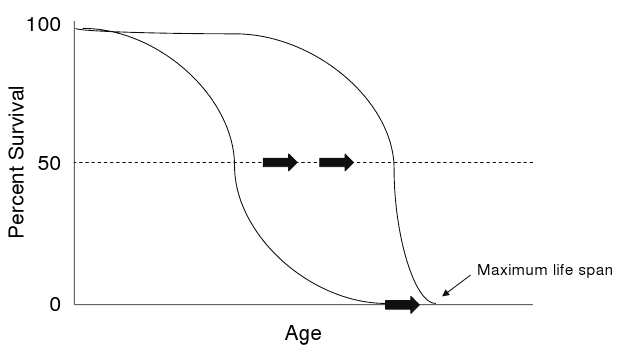
As mentioned in the case of the Okinawans, most likely dietary therapy to slow down many aspects of aging in humans and other mammals is caloric restriction. A 30 to 60 percent reduction of calories can produce extensions of both average and maximum life span (Figure 3).
Click image for larger view.
Extension of average and maximum life spans (block arrows) [e.g., by interventions such as caloric restriction] is thought to reflect changes in primary aging processes.
The life-lengthening effect of calorie restriction has been shown in experiments using a variety of species including worms, flies, fish, rodents, and in non-human primates. One study in rhesus monkeys showed that even when their calories were reduced when they were adults, they had fewer incidents of age-related deaths. Even more, the onset of age-related diseases like diabetes, cancer, cardiovascular disease, and neurological disease was delayed in monkeys who ate lower calorie diets. Even short-term studies on calorie restriction in humans have shown encouraging results (for instance, markers of delayed aging like improvements in blood glucose and insulin levels have been reported).
While calorie restriction may seem like an easy means to slow down the aging process (though maybe not the most desirable one), it’s important to note that the degree of caloric restriction that would be needed to achieve a true anti-aging effect is probably too severe to be practical for most of us. Therefore, it’s important for researchers to figure out exactly why calorie restriction works, and how it changes the age-dependent processes that cause functional decline.
There may be other dietary approaches that could extend maximum life span, but more research is still needed to understand how and why they work. One method is a low-methionine diet; methionine is an essential amino acid found in certain seeds, nuts, and meats. The life-lengthening effects of this diet seem to be totally separate from calorie restriction. Dietary supplementation with antioxidants has not yet been shown to significantly change median or maximum life span.
While calorie restriction may seem like an easy means to slow down the aging process (though maybe not the most desirable one), it’s important to note that the degree of caloric restriction that would be needed to achieve a true anti-aging effect is probably too severe to be practical for most of us.
The National Institute of Aging has organized a massive study of pharmaceuticals that have the potential to extend life span in various strains of mice. Of the drugs being tested, aspirin and nordihydroguaiaretic acid, a potent antioxidant, have been found to lead to significantly longer life spans in male mice, while rapamycin (an immunosuppressant drug used to prevent rejection in organ transplantation) leads to an increase in life span in both sexes. Other compounds currently being tested as part of this initiative can be found at http://www.nia.nih.gov/ResearchInformation/ScientificResources/CompoundsInTesting.htm.
Other changes like reduction in body temperature and increasing exercise have also been shown to affect life span. As examples, a low body temperature increases life span in many animals whose body temperatures change along with the environment (like certain lizards) and voluntary exercise in rats increases average life span. Habitual exercise does increase healthy life span in humans but whether it also extends the maximum length of life remains up for debate..
Centenarians are a rare breed: they are survivors, who escaped infant mortality, infectious illnesses in the pre-antibiotic era, as well as fatal outcomes of common age-related diseases. They exhibit an impressive delay of the onset of age-related illnesses – or they escape manage to survive that the diseases that typically cause mortality in other people at earlier ages. The mechanisms of extreme long life appear to be varied, (Figure 4), and can be accomplished by different combinations of genes, environment and chance that vary with culture and geography. It will be interesting, in coming years, to follow researchers as they continue to uncover just how we age – and perhaps understand the secrets of centenarians – and determine just what we may be able to do to live longer, healthier lives.

Click image for larger view.
Multiple pathways to exceptional longevity are possible. Interactions among pro-longevity factors are shown by arrows. Solid lines indicate currently non-modifiable factors; dashed lines indicate modifiable factors.