



 Editor's Note:
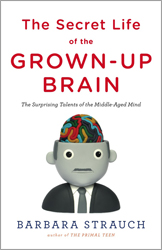
As Barbara Strauch points out in The Secret Life of the Grown-Up Brain, The Surprising Talents of the Middle-Aged Mind (2010, Viking), you brain is far more capable of handling new challenges than you may imagine. But challenge your brain you must. Write letters, do crosswords, learn something new.
Even the mental deterioration of Alzheimer's may be avoidable. Strauch describes research on people who showed no sign of dementia, and yet the autopsies done on on their brains showed tangles and plaques common to the disease. These cognitive reserves are believed to be the product of an active mind.
The following is an excerpt from Chapter 2.
A Bit Slower, but So Much Better
Here’s a short quiz. Look at the following list:
January February March April January February March May
January February March June January February March—
What would the next word be?
Got it? Now, how about this one:
January February Wednesday March April Wednesday
May June Wednesday July August Wednesday—
What would the next word be?
1 4 3 2 5 4 3 6 5
What would the next number be?
Did you get them all?
These are examples of questions that measure basic logic and reasoning. The answers are, in order, July, September, and, for the number sequence the next number would be 4 (and then 76. The series goes like this: 1- 43 2- 54 3- 65 4- 76 and so on). Such problems test our abilities to recognize patterns and are routinely used by scientists to see how our cognitive— or thinking— processes are holding up. And if you’re middle- aged and have figured out all of them, you can be proud— your brain is humming along just fine. Indeed, despite long- held beliefs to the contrary, there’s mounting evidence that at middle age we may be smarter than we were in our twenties.
How can we possibly be smarter and be putting the bananas in the laundry basket? Smarter and still unable, once we get to the hardware store, to remember why we went there in the first place?
To begin to understand how that might be, there is no better person to start with than Sherry Willis. A psychologist at Pennsylvania State University, Willis and her husband, K. Warner Schaie, run one of the longest, largest, and most respected life- span studies, the Seattle Longitudinal Study, which was started in 1956 and has systematically tracked the mental prowess of six thousand people for more than forty years. The study’s participants, chosen at random from a large health- maintenance organization in Seattle, are all healthy adults, evenly divided between men and women with varying occupations and between the ages of twenty and ninety. Every seven years, the Penn State team retests participants to find out how they are doing.
What’s important about this study is that it’s longitudinal, which means it studies the same people over time. For many years, researchers had information from only cross- sectional human life- span studies, which track different people across time looking for patterns. Most longitudinal studies, considered the gold standard for any scientific analysis, were not begun until the 1950s and are only now yielding solid information. And they show that we’ve been wildly misguided about our brains.
For instance, the first big results from the Seattle study, released just a few years ago, found that study participants functioned better on cognitive tests in middle age, on average, than they did at any other time they were tested.
The abilities that Willis and her colleagues measure include vocabulary— how many words you can recognize and find synonyms for; verbal memory— how many words you can remember; number ability— how quickly you can do multiplication, division, subtraction, and addition; spatial orientation— how well you can tell what an object would look like rotated 180 degrees; perceptual speed— how fast you can push a button when you see a green arrow; and inductive reasoning— how well you can solve logical problems similar to those mentioned above. While not perfect, the tests are a fair indicator of how well we do in certain everyday tasks, from deciphering an insurance form to planning a wedding.
In four out of six of the categories tested— vocabulary, verbal memory, spatial orientation, and, perhaps most heartening of all, inductive reasoning— people performed best, on average, between the ages of forty to sixty- five.
And what the researchers found is astounding. During the span of time that constitutes the modern middle age— roughly age forty through the sixties— the people in the study did better on tests of the most important and complex cognitive skills than the same group of people had when they were in their twenties. In four out of six of the categories tested— vocabulary, verbal memory, spatial orientation, and, perhaps most heartening of all, inductive reasoning— people performed best, on average, between the ages of forty to sixty- five.
“The highest level of functioning in four of the six mental abilities considered occurs in midlife,” Willis reports in her book Life in the Middle, “for both men and women, peak performance . . . is reached in middle age.
“Contrary to stereotypical views of intelligence and the naïve theories of many educated laypersons, young adulthood is not the developmental period of peak cognitive functioning for many of the higher order cognitive abilities. For four of the six abilities studied, middle- aged individuals are functioning at a higher level than they did at age 25.”
When I first learned of this, I was surprised. After researching the science on the adolescent brain, I knew that our brains continue to change and improve up to age twenty- five. Many scientists left it at that, believing that while our brains underwent large- scale renovations through our teens, that was about it. I, too, thought that as the brain entered middle age, it was solidified and staid, at best—and, more likely, if it was changing in any big way, was headed downhill.
After speaking with Willis one afternoon, I went out to dinner with friends and couldn’t resist talking about what was still whirring in my head. “Did you know,” I asked the middle- aged group over pasta and wine, “that our brains are better— better— than they were in our twenties?”
The reaction was swift.
“You’re crazy,” said one of my dinner companions, Bill, fifty- two, a civil engineer who owns his own consulting firm. “That’s simply not true. My brain is simply not as good as it was in my twenties, not even close. It’s not as fast; it’s harder to solve really hard problems. Come on, if I tried to go to Stanford engineering school today, I would be toast. TOAST!”
Bill is not wrong. Our brains do slow down by certain measures. We can be more easily distracted and, at times, find it more taxing to tackle difficult new problems, not to mention our inability to remember why we went down to the basement.
Bill does not have to go to school anymore, but even in his day- to- day work he compares his current brain to his younger brain and sees only its shortcomings. However, Bill is not seeing that his brain is far more talented than he gives it credit for. If you look at the data from the Willis research, the scores for those four crucial areas— logic, vocabulary, verbal memory, and spatial skills— are on a higher plane in middle age than the scores for the same skills ever were when those in her study were in their twenties. (There are also some interesting gender gaps. Top performance was reached a bit earlier on average for men, who peaked in their late fifties. Men also tended to hold on to processing speed a bit longer and do better overall with spatial tests. Women, on the other hand, consistently did better than men on verbal memory and vocabulary and their scores kept climbing later into their sixties.)
ISBN: 978-0-670-02071-3