


 Editor's Note:
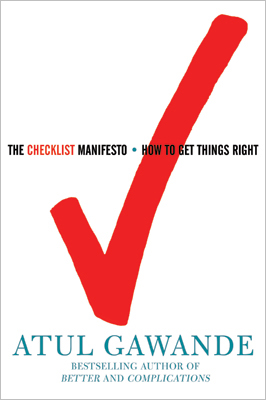
What he came up with was a checklist. This a simple tool helps keep knowledge in the driver's seat when complexity threatens to overwhelm an individual's ability to remember to do everything they know is right, whether they are performing surgery, piloting a plane in difficult conditions, building a skyscraper or trying to figure out how to make a restaurant run smoothly.
He was stable, breathing normally, not in pain, just drunk and babbling to the trauma team. They cut off his clothes with shears and looked him over from head to toe, front and back. He was of moderate size, about two hundred pounds, most of the excess around his middle. That was where they found the stab wound, a neat two− inch red slit in his belly, pouting open like a fish mouth. A thin mustard yellow strip of omental fat tongued out of it— fat from inside his abdomen, not the pale yellow, superficial fat that lies beneath the skin. They’d need to take him to the operating room, check to make sure the bowel wasn’t injured, and sew up the little gap.
If it were a bad injury, they’d need to crash into the operating room— stretcher flying, nurses racing to get the surgical equipment set up, the anesthesiologists skipping their detailed review of the medical records. But this was not a bad injury. They had time, they determined. He lay waiting on his stretcher in the stucco− walled trauma bay while the OR was readied.
Then a nurse noticed he’d stopped babbling. His heart rate had skyrocketed. His eyes were rolling back in his head. He didn’t respond when she shook him. She called for help and the members of the trauma team swarmed back into the room. His blood pressure was barely detectible. They stuck a tube down his airway and pushed air into his lungs, poured fluid and emergency−release blood into him. Still they couldn’t get his pressure up.
The blood was everywhere. The assailant’s knife had gone more than a foot through the man’s skin, through the fat, through the muscle, past the intestine, along the left of his spinal column, and right into the aorta, the main artery from the heart.
So now they were crashing into the operating room— stretcher flying, nurses racing to get the surgical equipment set up, the anesthesiologists skipping their review of the records, a resident splashing a whole bottle of Betadine antiseptic onto his belly, John grabbing a fat No. 10 blade and slicing down through the skin of the man’s abdomen in one clean, determined swipe from rib cage to pubis.
“Cautery.”
“No big deal,” John said.
He drew the electrified metal tip of the cautery pen along the fat underneath the skin, parting it in a line from top to bottom, then through the fibrous white sheath of fascia between the abdominal muscles. He pierced his way into the abdominal cavity itself, and suddenly an ocean of blood burst out of the patient.
“Crap.”
The blood was everywhere. The assailant’s knife had gone more than a foot through the man’s skin, through the fat, through the muscle, past the intestine, along the left of his spinal column, and right into the aorta, the main artery from the heart.
“Which was crazy,” John said. Another surgeon joined to help and got a fist down on the aorta, above the puncture point. That stopped the worst of the bleeding and they began to get control of the situation. John’s colleague said he hadn’t seen an injury like it since Vietnam.
[They] got almost every step right -- the...examination, the careful tracking of the patient's blood pressure and pulse...the call to the blood bank to have blood ready...Except no one remembered to ask the patient or the emergency medical technicians what the weapon was.
The description was pretty close, it turned out. The other guy at the costume party, John later learned, was dressed as a soldier— with a bayonet.
The patient was touch and go for a couple days. But he pulled through. John still shakes his head ruefully when he talks about the case.
There are a thousand ways that things can go wrong when you’ve got a patient with a stab wound. But everyone involved got almost every step right— the head− to− toe examination, the careful tracking of the patient’s blood pressure and pulse and rate of breathing, the monitoring of his consciousness, the fluids run in by IV, the call to the blood bank to have blood ready, the placement of a urinary catheter to make sure his urine was running clear, everything. Except no one remembered to ask the patient or the emergency medical technicians what the weapon was.
“Your mind doesn’t think of a bayonet in San Francisco,” John could only say.
He told me about another patient, who was undergoing an operation to remove a cancer of his stomach when his heart suddenly stopped.* John remembered looking up at the cardiac monitor and saying to the anesthesiologist, “Hey, is that asystole?” Asystole is total cessation of heart function. It looks like a flat line on the monitor, as if the monitor is not even hooked up to the patient.
The anesthesiologist said “A lead must have fallen off,” because it seemed impossible to believe that the patient’s heart had stopped. The man was in his late forties and had been perfectly healthy. The tumor was found almost by chance. He had gone to see his physician about something else, a cough perhaps, and mentioned he’d been having some heartburn, too. Well, not heartburn exactly. He felt like food sometimes got stuck in his esophagus and wouldn’t go down and that gave him heartburn. The doctor ordered an imaging test that required him to swallow a milky barium drink while standing in front of an X−ray machine. And there on the images it was: a fleshy mouse− size mass, near the top of the stomach, intermittently pressing up against the entrance like a stopper. It had been caught early. There were no signs of spread. The only known cure was surgery, in this case a total gastrectomy, meaning removal of his entire stomach, a major four− hour undertaking.
They were getting ready to reconstruct the patient's digestive tract when the monitor went flat-line...The anesthesiologist could feel no pulse in the patient's carotid artery. His heart had stopped.
The team members were halfway through the procedure. The cancer was out. There’d been no problems whatsoever. They were getting ready to reconstruct the patient’s digestive tract when the monitor went flat− line. It took them about five seconds to figure out that a lead had not fallen off. The anesthesiologist could feel no pulse in the patient’s carotid artery. His heart had stopped.
John tore the sterile drapes off the patient and started doing chest compressions, the patient’s intestines bulging in and out of his open abdomen with each push. A nurse called a Code Blue.
John paused here in telling the story and asked me to suppose I was in his situation. “So now, what would you do?”
I tried to think it through. The asystole happened in the midst of major surgery. Therefore, massive blood loss would be at the top of my list. I would open fluids wide, I said, and look for bleeding.
When he left, nothing seemed remotely off− kilter. He kept thinking to himself, someone must have done something wrong.
That’s what the anesthesiologist said, too. But John had the patient’s abdomen completely open. There was no bleeding, and he told the anesthesiologist so.
“He couldn’t believe it,” John said. “He kept saying, ‘There must be massive bleeding! There must be massive bleeding!’ ” But there was none.
Lack of oxygen was also a possibility. I said I’d put the oxygen at 100 percent and check the airway. I’d also draw blood and send it for stat laboratory tests to rule out unusual abnormalities.
John said they thought of that, too. The airway was fine. And as for the lab tests, they would take at least twenty minutes to get results, by which point it would be too late.
Could it be a collapsed lung— a pneumothorax? There were no signs of it. They listened with a stethoscope and heard good air movement on both sides of the chest.
The cause therefore had to be a pulmonary embolism, I said— a blood clot must have traveled to the patient’s heart and plugged off his circulation. It’s rare, but patients with cancer undergoing major surgery are at risk, and if it happens there’s not much that can be done. One could give a bolus of epinephrine— adrenalin—to try and jump− start the heart, but it wouldn’t likely do much good.
John said that his team had come to the same conclusion. After fifteen minutes of pumping up and down on the patient’s chest, the line on the screen still flat as death, the situation seemed hopeless. Among those who arrived to help, however, was a senior anesthesiologist who had been in the room when the patient was being put to sleep. When he left, nothing seemed remotely off− kilter. He kept thinking to himself, someone must have done something wrong.
He asked the anesthesiologist in the room if he had done anything different in the fifteen minutes before the cardiac arrest.
No. Wait. Yes. The patient had had a low potassium level on routine labs that were sent during the first part of the case, when all otherwise seemed fine, and the anesthesiologist had given him a dose of potassium to correct it.
I was chagrined at having missed this. An abnormal level of potassium is a classic potential cause of asystole. It’s mentioned in every textbook. I couldn’t believe I overlooked it. Severely low potassium levels can stop the heart, in which case a corrective dose of potassium is the remedy. And too much potassium can stop the heart, as well— that’s how states execute prisoners.
The senior anesthesiologist asked to see the potassium bag that had been hanging. Someone fished it out of the trash and that was when they figured it out. The anesthesiologist had used the wrong concentration of potassium, a concentration one hundred times higher than he’d intended. He had, in other words, given the patient a lethal overdose of potassium.
The surgical team was so shaken they weren’t sure they could finish the operation. They’d not only nearly killed the man but also failed to recognize how.
After so much time, it wasn’t clear whether the patient could be revived. It might well have been too late. But from that point on, they did everything they were supposed to do. They gave injections of insulin and glucose to lower the toxic potassium level. Knowing that the medications would take a good fifteen minutes to kick in— way too long— they also gave intravenous calcium and inhaled doses of a drug called albuterol, which act more quickly. The potassium levels dropped rapidly. And the patient’s heartbeat did indeed come back.
The surgical team was so shaken they weren’t sure they could finish the operation. They’d not only nearly killed the man but also failed to recognize how. They did finish the procedure, though. John went out and told the family what had happened. He and the patient were lucky. The man recovered— almost as if the whole episode had never occurred.
The stories surgeons tell one another are often about the shock of the unexpected— the bayonet in San Francisco, the cardiac arrest when all seemed fine— and sometimes about regret over missed possibilities. We talk about our great saves but also about our great failures, and we all have them. They are part of what we do. We like to think of ourselves as in control. But John’s stories got me thinking about what is really in our control and what is not.
In the 1970s, the philosophers Samuel Gorovitz and Alasdair MacIntyre published a short essay on the nature of human fallibility that I read during my surgical training and haven’t stopped pondering since. The question they sought to answer was why we fail at what we set out to do in the world. One reason, they observed, is “necessary fallibility”— some things we want to do are simply beyond our capacity. We are not omniscient or all−powerful. Even enhanced by technology, our physical and mental powers are limited. Much of the world and universe is— and will remain— outside our understanding and control.
There are substantial realms, however, in which control is within our reach. We can build skyscrapers, predict snowstorms, save people from heart attacks and stab wounds. In such realms, Gorovitz and MacIntyre point out, we have just two reasons that we may nonetheless fail.
The first is ignorance— we may err because science has given us only a partial understanding of the world and how it works. There are skyscrapers we do not yet know how to build, snowstorms we cannot predict, heart attacks we still haven’t learned how to stop. The second type of failure the philosophers call ineptitude— because in these instances the knowledge exists yet we might fail to apply it correctly. This is the skyscraper that is built wrong and collapses, the snowstorm whose signs the meteorologist just plain missed, the stab wound from a weapon the doctors forgot to ask about.
Thinking about John’s cases as a small sample of the difficulties we face in early− twenty− first− century medicine, I was struck by how greatly the balance of ignorance and ineptitude has shifted. For nearly all of history, people’s lives have been governed primarily by ignorance. This was nowhere more clear than with the illnesses that befell us. We knew little about what caused them or what could be done to remedy them. But sometime over the last several decades— and it is only over the last several decades— science has filled in enough knowledge to make ineptitude as much our struggle as ignorance.
Consider heart attacks. Even as recently as the 1950s, we had little idea of how to prevent or treat them. We didn’t know, for example, about the danger of high blood pressure and had we been aware of it we wouldn’t have known what to do about it. The first safe medication to treat hypertension was not developed and conclusively demonstrated to work until the 1960s. We didn’t know about the role of cholesterol, either, or genetics or smoking or diabetes.
But sometime over the last several decades — and it is only over the last several decades — science has filled in enough knowledge to make ineptitude as much our struggle as ignorance.
Furthermore, if someone had a heart attack, we had little idea of how to treat it. We’d give some morphine for the pain, perhaps some oxygen, and put the patient on strict bed rest for weeks— patients weren’t even permitted to get up and go to the bathroom for fear of stressing their damaged heart. Then everyone would pray and cross their fingers and hope the patient would make it out of the hospital to spend the rest of his or her life at home as a cardiac cripple.
Today, by contrast, we have at least a dozen effective ways to reduce your likelihood of having a heart attack— for instance, controlling your blood pressure, prescribing a statin to lower cholesterol and inflammation, limiting blood sugar levels, encouraging exercise regularly, helping with smoking cessation, and, if there are early signs of heart disease, getting you to a cardiologist for still further recommendations. If you should have a heart attack, we have a whole panel of effective therapies that can not only save your life but also limit the damage to your heart: we have clot− busting drugs that can reopen your blocked coronary arteries; we have cardiac catheters that can balloon them open; we have open heart surgery techniques that let us bypass the obstructed vessels; and in some instances, we’ve learned that all we really have to do is send you to bed with some oxygen, an aspirin, a statin, and blood pressure medications— in a couple days you’ll generally be ready to go home and gradually back to your usual life.
But now the problem we face is ineptitude, or maybe it’s “eptitude”— making sure we apply the knowledge we have consistently and correctly. Just making the right treatment choice among the many options for a heart attack patient can be difficult, even for expert clinicians. Furthermore, what ever the chosen treatment, each involves abundant complexities and pitfalls. Careful studies have shown, for example, that heart attack patients undergoing cardiac balloon therapy should have it done within ninety minutes of arrival at a hospital. After that, survival falls off sharply. In practical terms this means that, within ninety minutes, medical teams must complete all their testing for every patient who turns up in an emergency room with chest pain, make a correct diagnosis and plan, discuss the decision with the patient, obtain his or her agreement to proceed, confirm there are no allergies or medical problems that have to be accounted for, ready a cath lab and team, transport the patient, and get started.
What is the likelihood that all this will actually occur within ninety minutes in an average hospital? In 2006, it was less than 50 percent.
This is not an unusual example. These kinds of failures are routine in medicine. Studies have found that at least 30 percent of patients with stroke receive incomplete or inappropriate care from their doctors, as do 45 percent of patients with asthma and 60 percent of patients with pneumonia. Getting the steps right is proving brutally hard, even if you know them.
I have been trying for some time to understand the source of our greatest difficulties and stresses in medicine. It is not money or government or the threat of malpractice lawsuits or insurance company hassles— although they all play their role. It is the complexity that science has dropped upon us and the enormous strains we are encountering in making good on its promise. The problem is not uniquely American; I have seen it everywhere— in Europe, in Asia, in rich countries and poor. Moreover, I have found to my surprise that the challenge is not limited to medicine.
Know−how and sophistication have increased remarkably across almost all our realms of endeavor, and as a result so has our struggle to deliver on them. You see it in the frequent mistakes authorities make when hurricanes or tornadoes or other disasters hit. You see it in the 36 percent increase over the last four years in lawsuits against attorneys for legal mistakes— the most common being simple administrative errors, like missed calendar dates and clerical screw ups, as well as errors in applying the law. You see it in flawed software design, in foreign intelligence failures, in our tottering banks— in fact, in almost any endeavor requiring mastery of complexity and of large amounts of knowledge.
Know−how and sophistication have increased remarkably across almost all our realms of endeavor, and as a result so has our struggle to deliver on them.
Such failures carry an emotional valence that seems to cloud how we think about them. Failures of ignorance we can forgive. If the knowledge of the best thing to do in a given situation does not exist, we are happy to have people simply make their best effort. But if the knowledge exists and is not applied correctly, it is difficult not to be infuriated. What do you mean half of heart attack patients don’t get their treatment on time? What do you mean that two− thirds of death penalty cases are overturned because of errors? It is not for nothing that the philosophers gave these failures so unmerciful a name—ineptitude. Those on the receiving end use other words, like negligence or even heartlessness.
For those who do the work, however— for those who care for the patients, practice the law, respond when need calls— the judgment feels like it ignores how extremely difficult the job is. Every day there is more and more to manage and get right and learn. And defeat under conditions of complexity occurs far more often despite great effort rather than from a lack of it. That’s why the traditional solution in most professions has not been to punish failure but instead to encourage more experience and training.
There can be no disputing the importance of experience. It is not enough for a surgeon to have the textbook knowledge of how to treat trauma victims— to understand the science of penetrating wounds, the damage they cause, the different approaches to diagnosis and treatment, the importance of acting quickly. One must also grasp the clinical reality, with its nuances of timing and sequence. One needs practice to achieve mastery, a body of experience before one achieves real success. And if what we are missing when we fail is individual skill, then what is needed is simply more training and practice.
But what is striking about John’s cases is that he is among the best trained surgeons I know, with more than a decade on the front lines. And this is the common pattern. The capability of individuals is not proving to be our primary difficulty, whether in medicine or elsewhere. Far from it. Training in most fields is longer and more intense than ever. People spend years of sixty−, seventy−, eighty− hour weeks building their base of knowledge and experience before going out into practice on their own— whether they are doctors or professors or lawyers or engineers. They have sought to perfect themselves. It is not clear how we could produce substantially more expertise than we already have. Yet our failures remain frequent. They persist despite remarkable individual ability.
Here, then, is our situation at the start of the twenty− first century: We have accumulated stupendous know− how. We have put it in the hands of some of the most highly trained, highly skilled, and hardworking people in our society. And with it, they have indeed accomplished extraordinary things. Nonetheless, that know− how is often unmanageable. Avoidable failures are common and persistent, not to mention demoralizing and frustrating, across many fields— from medicine to finance, business to government. And the reason is increasingly evident: the volume and complexity of what we know has exceeded our individual ability to deliver its benefits correctly, safely, or reliably. Knowledge has both saved us and burdened us.
That means we need a different strategy for overcoming failure, one that builds on experience and takes advantage of the knowledge people have but somehow also makes up for our inevitable human inadequacies. And there is such a strategy— though it will seem almost ridiculous in its simplicity, maybe even crazy to those of us who have spent years carefully developing ever more advanced skills and technologies.
It is a checklist.