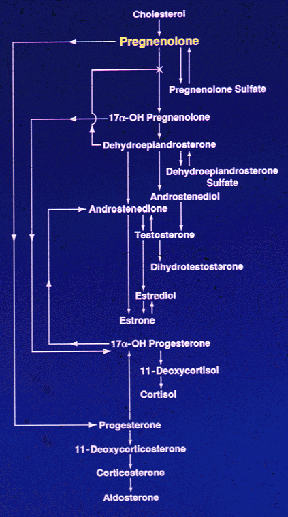
For reasons that are not totally clear, DHEA (dehyrdoepiandrosterone) has captured the public and scientific imagination as an anti-aging hormone. It has been characterized as the "mother hormone" — a precursor of all steroid hormones, which it is not — that honor belongs to pregnenolone (Figure 1). Yet DHEA has shown sufficient promise as the promised fountain of youth, for which man has endlessly searched, that we need to look at what we know about DHEA, as well as what it can and cannot do.
Figure 1.
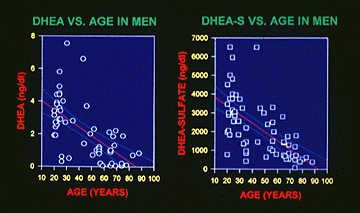
In 1947, Francis Albright, the father of modern endocrinology (the study of human hormones and hormone-producing glands) predicted that secretion of the male hormone, androgen, would fall with age. He suggested that this should be called the "adrenopause." Subsequently, numerous studies have reported that DHEA and its sulfated form decrease dramatically with age. As Figure 2 shows, DHEA levels drop by 20 to 30% over the lifespan.
Figure 2.
Animal and Statistical Studies
Animal and statistical studies have suggested that DHEA can influence multiple systems affecting aging.
In mice, DHEA reverses numerous of the findings of immune system old age. Old mice once again respond to vaccinations and are able to fight off otherwise lethal viral or parasitic infections.
DHEA protects rabbits, overfed a fat-laden diet, from developing cholesterol build-up and hardening of their arteries (atherosclerosis). Human studies have been inconclusive, with some suggesting DHEA lowers the chance of heart attacks and another early study in the 1950s indicating that chest pain (angina) could be successfully treated with DHEA.
In mice DHEA decreased fat gain without decreasing appetite. This suggested that DHEA may be a metabolic antiobesity agent. Human studies have failed to demonstrate the same effects.
DHEA enhanced memory in young and old mice. In nursing home residents, those with better function had higher DHEA levels.
Osteoporosis
Large statistical studies suggest a correlation between low DHEA levels and osteoporosis.
Free Radicals
Free radicals are suspected as possible cancer promoters. In rats, DHEA made matters worse, decreasing enzymes that deactivate the free radicals as they form.
Cancer
The evidence is inconsistent. While DHEA inhibits formation of breast tumors in mice and low levels of DHEA have been associated with breast cancer, DHEA seems to promote breast cancer in postmenopausal women.
Human Studies
DHEA was first given to humans in the early 1950s. It was predominantly prescribed with estrogen in Germany to treat menopausal symptoms. Between 1952 to 1975, DHEA was marketed in the United Kingdom for the management of asthenia (a condition characterized by lack of energy and appetite). The dose was 5 to 30 mg daily. Although no side effects were reported, it was withdrawn from the market because of poor sales.
Sammy Yen and his colleagues have undertaken three studies on the effects of oral DHEA administration. In the first study, they gave 13 men and 17 women, aged 40 to 70 years of age, 50 mg DHEA at night. Positive findings were few. DHEA and its sulfate levels increased and in women there was an increase in the male hormone, testosterone, as well. Libido did not change but subjects had "a remarkable increase in perceived physical and psychological well-being."
In the second study, eight men and eight women, aged 50 to 65 years of age, received 100 mg of DHEA daily for one year. Testosterone increased in women and one woman developed facial hair. DHEA increased lean body mass, decreased fat mass and increased strength in men.
In a third study, nine older males took 50 mg DHEA for five months. White cells, which help the body fight infection, increased, as did some other immune agents. However, another research team found that DHEA had opposite effects, reducing counts for some immune cells.
DHEA has been given as a 10% cream for 12 months to fifteen 60-70 year old women. A decrease in fat and an increase in muscle mass and a decrease in fasting glucose and insulin levels was noted. However, an 8% decrease in HDL cholesterol, the good cholesterol,was also observed. In very small study, medical scientists found that DHEA evoked a considerable antidepressant effect, but better designed drugs trials will be necessary before DHEA can be considered an antidepressant.
Conclusion
Overall, the available human studies suggest that DHEA may be a "feel good" pill for middle aged persons — perhaps the next Prozac®. To me, this conjures up images of Aldous Huxley's Brave New World and George Orwell's 1984, where a complacency pill removes desire to achieve or question the system. I think DHEA still has a long way to go to prove itself a useful contender for a place in the hormonal Fountain of Youth Hall of Fame.
As the outstanding medical statistician and scientist, Elizabeth Barrett-Connor, remarked at a three-day meeting on DHEA, sponsored by the New York Academy of Sciences in June, 1995, "Every five years a new wonder drug comes along. I don't think DHEA is the wonder drug people at this meeting seem to think it is."
Postscript: DHEA in Health Food Stores
Most DHEA in health food stores claims to be the "natural" DHEA, an extract of yam that contains the plant hormone, discogenin (the Latin name for yam is Discorea). Lack of standardization makes buying these products a true "pig in the poke" — in other words, you don't know what you are getting. Buyer beware!