


Alice H. Lichtenstein, D. Sc., is an Associate Professor of Nutrition in the School of Nutrition Science and an Associate Professor of Family Medicine, Community Health at Tufts University School of Medicine. Her research investigates the behavior of lipoprotein molecules. particles, predictive factors for changes in blood lipids induced by diet in individuals. Dr. Lichtenstein is on the Editorial Board of the Journal of Nutrition and Atherosclerosis.
Being Thin Is Not Necessarily the Solution
RMR
How important a factor is dietary fat intake in the development of coronary artery disease? Put another way, if a person has a high fat diet but stays relatively thin will their arteries be okay?
AHL
You can't tell by looking at someone whether they are of a desirable body weight or overweight, or their risk of developing heart disease. Each person is different.
First, you have to know how much fat (lipid) is in your blood (see Table 1 below for more detail). Most physicians do this blood test every time you have a check-up or annual medical exam. The most important factor affecting blood cholesterol levels is how much saturated fat and cholesterol you eat.
Table 1.
Classification on the Basis of Total Cholesterol Levels
| < 200 mg/dl | (< 5.2 mmol/L) | Desirable cholesterol |
| 201-239 mg/dl | (5.2-6.2 mmol/L) | Borderline-high cholesterol |
| > 240 mg/dl | (> 6.2 mmol/L) | High cholesterol |
Risk Factors Vary with the Individual, but They Do Add Up
RMR
What risk factors affect your blood lipid levels? Alice, you mentioned the various risk factors for coronary artery disease and I wonder if you would list them in order of importance as a review and, secondly, could you review the main sources of saturated fats in our diet and the mechanism whereby saturated fats give rise to elevated cholesterol levels?
AHL
The significant risk factors are hypertension, family history of cardiovascular disease, current cigarette smoker, hypertension, low HDL cholesterol (the good cholesterol) and diabetes. Although not considered independent risk factors,obesity and physical inactivity should also be taken into consideration. No one risk factor is more important than another (see Table 2 below).
Table 2.
Positive and Negative Risk Factors
| Positive Risk Factors |
|---|
|
Age Male > 45 years Female > 55 years or premature menopause without estrogen replacement therapy |
| History of Premature CHD Myocardial infarction or sudden death before 55 years or 65 years of age in parent or first-degree relative, male female, respectively |
|
Current Cigarette Smoking Hypertension Blood pressure > 140/90 mm Hg (should be confirmed) or taking antihypertensive medication |
| Negative Risk Factor (subtract one positive risk factor) |
| High HDL cholesterol (> 60 mg/dl [1.6 mmol/L]) |
First, we classify a person based on their cholesterol level. An individual with two or more risk factors, for example, and in the borderline high-risk range, according to their blood cholesterol, would be bumped up to a high-risk category and treated more aggressively (Table 4). For individuals with low HDL (the good cholesterol), we can also classify them based on their LDL (bad cholesterol levels) (Table 5). In Table 6, we've listed the recommended treatment and target LDL levels.
Major Sources of Saturated Fat in the Diet
AHL
The American Heart Association (AHA) and the National Cholesterol Education Program (NCEP) have issued recommended guidelines, Step 1 and Step 2 they're called, for the dietary treatment of too much cholesterol Table 3. The patient should be first counseled to follow a Step 1 diet. If a patient is already on a Step 1 diet, or an acceptable response is not achieved, the patient should be advised to follow a Step 2 diet by further decreasing their saturated fat intake to 7% of calories and their cholesterol intake to 200 mg/day. For this strategy to be effective, you'll probably require the help of a registered dietitian. Usually, decreasing the total fat content of the diet is easier to do than decreasing the saturated fat content. In order to decrease effectively the saturated fat content, it is important to know its major sources. These include animal fats such as meat and full fat dairy products and, depending on one's tastes, a few selected plant oils (Table 7). The plant oils, frequently termed tropical oils, include coconut oil, palm oil, palm kernel oil and cocoa butter and contain a fair amount of saturated fat. However, they do not tend to be used in high levels in the United States.
For Americans with high blood lipid levels, the focus should be on decreasing full fat dairy products and meat. Many non-fat, reduced-fat and low-fat dairy products are now available. To reduce the intake of saturated fat from meat, buy cuts of meat with the least amount of visible fat; trim meat of excess fat; with poultry, remove the skin before eating; and, of course, cut down on the size portion of meat actually consumed.
The other potential source of animal fat can come from cooking, as discretionary fat is added during food preparation. We recommend that individuals switch from animal fats such as lard or butter to vegetable oils.
The other dietary factor which elevates blood cholesterol levels is dietary cholesterol. Major sources of dietary cholesterol are eggs and animal fats (both dairy and meat). By decreasing the consumption of animal fat, in addition to saturated fat, dietary cholesterol intake should also decrease.
Trans Fatty Acids — Do They Help?
RMR
What's your opinion about trans fatty acids and whether they are a critical dietary factor that causes increased heart disease?
AHL
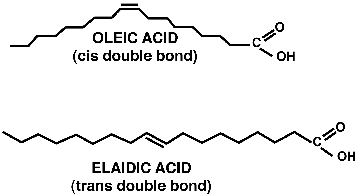
Trans fatty acid is a shorthand term for a fatty acid that contains at least one double bond in the trans (opposite sides) configuration. The naturally occurring double bonds are all on the same side, the so-called cis configuration (Figure 1). The trans configuration most resembes saturated fatty acid.
Figure 1.
Figure 1. Cis and trans configurations of fatty acids.
Trans fatty acids are hydrogenated to increase their stability and plasticity or consistency. The idea behind hydrogenation of vegetable oil was to transforms its unsaturated fatty acids into products, such as margarine, that could be used in place of butter, which is composed, predominantly, of saturated fatty acids.
Trans fatty acids have been in the diet for a long time. One of their effects, the increase in the levels of total and LDL (the bad) cholesterol, was already known, but another effect, on plasma cholesterol levels, wasn't suggested until 1990, wherein the authors suggested that trans fatty acids decreased HDL (the good) cholesterol levels. It was also suggested at that time that Western diets contained significant enough levels of trans fatty acids that the situation should be reassessed. Since then, a number of studies have been done, most quite consistent with the early work showing that trans fatty acids increase total and LDL cholesterol levels.
If you lower the level of trans fatty acids in your diet, something else is going to be substituted. I think this is where some of the confusion and arguments in the scientific community have arisen. Hard margarine and prepared foods that use hydrogenated fat in the processing are the main sources of trans fatty acids. If you cut down on margarine, but replace it with butter, you will increase the saturated fat intake and that's not good. If you substitute a liquid oil or soft margarine for stick margarine, then you are decreasing the trans fatty acid intake and increasing the unsaturated fat intake. This would probably have a beneficial effect.If you substitute a liquid oil or soft margarine for stick margarine, then you are decreasing the trans fatty acid intake and increasing the unsaturated fat intake. This would probably have a beneficial effect.
The Omega-3 Fatty Acids — Just Fish Oil?
RMR
What's the latest thinking on the omega-3 fatty acids found most often in fish oils? Do you think they prevent heart disease?
AHL
Omega-3 fatty acids are long chain fatty acids and usually contain three or more double bonds. They are found in marine products and some vegetable oils, such as soybean or canola. They have very little impact on blood cholesterol levels., but they can lower plasma triglyceride levels, especially in individuals who have elevated triglyceride levels. This is particularly important because when plasma triglyceride levels go down, the HDL (the good cholesterol) level goes up.
If you eat more fish as an entrée, you will also displace high saturated fat meat from your diet, so you'll benefit both from the effects of more omega-3 fatty acids and less saturated fat intake.
Exercise, Alcohol and Lower Cholesterol
RMR
With regard to HDL, we have heard that exercise can increase HDL levels. And there are studies indicating that higher vitamin C levels in the diet and moderate alcohol intake — one or two drinks a day as opposed to none or large amounts — are correlated with higher HDL levels. What do you recommend?
AHL
In terms of raising HDL cholesterol levels, these factors are difficult to assess. But, obviously, there are other reasons, in addition to HDL cholesterol levels, that one would encourage moderate, not excessive, alcohol intake and regular exercise.
The case for vitamin C is weaker. However, diets or dietary patterns that tend to be high in vitamin A tend also to be high in fruits and vegetables (and antioxidant vitamins) and lower in total fat, saturated fat and cholesterol.
RMR
What about lipoprotein (a)?
AHL
There is good evidence to suggest that the higher your level of this fat protein, Lp(a), the more likely you will develop heart disease. The problem is that Lp(a) levels are determined by genetics and not as much by diet or lifestyle. But there have been some reports, for example, that trans fatty acids may increase Lp(a) levels.
RMR
Finally, I would like you to summarize what you should do if a doctor tells you that you have a cholesterol level of say 250? Or if you find out your triglyceride level is 210 (quite above the normal range)?
AHL
In the first situation, if the doctor also tells you that your HDL cholesterol levels are below 35 mg/dl, you will need a blood test to determine your LDL cholesterol level. Once you know your LDL level, the information in Table 5 can help decide the best course of primary prevention. If you have additional risk factors, especially existing heart disease (CHD), this will determine at what LDL level therapy is initiated (Table 6).
If you are told you have a high triglyceride level of 210 mg/dl, the first thing to do is to ask the doctor to repeat the determination, making certain you have fasted and that LDL and HDL cholesterol levels are determined. If you only have elevated triglyceride levels, issues related to excess alcohol consumption need to be confronted. Frequently, limiting consumption of simple carbohydrate (sugar) and alcohol is helpful in bringing down high triglyceride levels.what you should do if a doctor tells you that you have a cholesterol level of say 250? Or if you find out your triglyceride level is 210 (quite above the normal range)?
15% Reduction in Cholesterol Levels by Diet Alone
RMR
How much of a change in cholesterol can one expect by diet alone? When should your doctor switch you from diet to medication for cholesterol lowering purposes?
AHL
From diet alone, we can expect a 5% to 15% decrease in blood cholesterol levels. If a doctor sees that you are responding on the low side, it is important to determine whether this low response is due to poor adherence to the dietary recommendation, a misunderstanding of what the dietary recommendations are, overall non-compliance with the recommendations or if you are simply a non-responder to dietary intervention. Obviously, it is not easy to sort out reasons for low response. However, our work has clearly shown that in individuals provided with all their food and drink, and that we were reasonably certain were compliant, we observe, on average, a 15% decrease in blood cholesterol.
When should the doctor decide to go from diet to medication for cholesterol lowering purposes? I suggest to doctors that their patients have a three-month period to alter their diet. If the LDL cholesterol level reamins high, then medication may be necessary (Table 6).
The Truth About Olive Oil
RMR
My final question is about olive oil. This has certainly been in fashion lately, both in restaurants and in the media, and is almost being promoted as a health food. Does olive oil have some particular advantages over unsaturated fats that we should be emphasizing it to such a degree as indicated in magazines we read?
AHL
Olive oil is classified as a vegetable oil, as are many other oils. Most vegetable oils, except for the tropical oils (Table 7),are relatively high in unsaturated fatty acids. There are two subclassifications for unsaturated fatty acids, monounsaturated and polyunsaturated. Examples of oils that are relatively high in monounsaturated fatty acids include olive oil and canola oil. Examples of oils that are relatively high in polyunsaturated fatty acids are corn, soy bean and sun flower seed oils.
Substituting vegetable oils for animals fats will reduce the saturated fat intake and result in lower blood cholesterol levels. Is olive oil particularly special relative to other vegetable oils? Probably not. It is high in monounsaturated fatty acids, but cannola oil is also high in monounsaturated fatty acids. Do I think it is a good oil? Yes. Is it as good as any of the other vegetable oils, especially vegetable oils high in monounsaturated fatty acids? Is it better? The jury's still out. It's certainly not magical. One danger is the misconception that, if a little bit is good, then a lot is better, which is not what anyone is trying to imply. Certainly, it is better to use olive oil than to use saturated fat. However, it is also important to remember that, for some people, with respect to total energy balance and fat intake, it is important to be moderate in one's consumption of all types of fat.
So is pouring olive oil over a hot fudge sundae going to make it better for you? Unlikely.