


JM
In 1900, 4% of the U.S. population was over the age of 65. Today, that figure stands at 12%. If current projections are correct, the elderly will comprise approximately 20% of the U.S. population by the year 2020. Projections for northern Europe suggest even higher numbers will be present in Europe.
Not only are we growing older as a society, but the lifestyles of the elderly are changing as well. Of all Americans who turned 65 in the year 1990, it is estimated that about half will have spent time in a chronic care institution at some point in their lives. Of that half, approximately 50% will have spent more than a year at the facility. This is an important consideration because the nutritional needs of people living in chronic care institutions differ somewhat from those living independently.
One example is the issue of vitamin D. All elderly people are prone to vitamin D depletion, but this is a particular concern for those who are in a nursing home or a hospital, partly because of poor diet and partly because of insufficient exposure to sunlight.
These trends have prompted considerable research into the physiology of aging over the past decade. Rob, can you talk about gastrointestinal tract changes that accompany aging and the impact these have on nutrition?
Absorption of Fat, Protein and Carbohydrates
RMR
First, I want to talk about how the elderly person handles macronutrients, that is, fat, protein, and carbohydrates. We did a study of nearly 100 people ranging in age from 20 to 95. We put them on a diet of 100 g/day of fat for a period of six days. Because the body's ability to absorb fat was thought to decrease with age, we expected to find that our subjects would excrete more fat but they didn't.
Previous studies, using rats, had shown that the pancreas, an organ that helps the body absorb fat, loses function gradually during the aging process. Although the human pancreas does lose some function with age, this does not prevent the digestion of normal amounts of dietary fat, certainly up to the level of 100 g/day. Our study concluded that the elderly can absorb normal amounts of dietary fat just as well as they did when they were 20.
The results would be different if you increased dietary fat to unhealthy levels, say 120-130 g/day. At these very high fat doses, the older person will have absorption problems and start excreting higher amounts of fecal fat than a younger person.
Much the same holds true for protein. The older person can handle normal levels of dietary protein just as well as a young person and does not experience absorption problems. However, when eating a very high protein diet, the older person begins to excrete higher amounts of protein. Let me stress that the levels of fat and protein that cause absorption problems in the elderly are far in excess of what an average person would really eat.
When it comes to carbohydrates, the situation is less clear because good studies have not been done. One study found increased breath hydrogen, a measure of carbohydrate malabsorption, in elderly people who had been put on an extremely high-carbohydrate diet, (as much as 200g of carbohydrate per meal). In contrast, the younger person's breath hydrogen did not increase. However, the subjects of this study were never screened for certain medical conditions that are common among the elderly that can change the test results. We cannot, therefore, conclude from this evidence alone that older people have any greater difficulty in absorbing carbohydrates than do younger people.
Joel, can you address the subject of "sarcopenia" or the wasting away of muscle, in the elderly? We now know this condition is not caused by difficulty in absorbing protein or calories. What is the cause?
Sarcopenia: What Can You Do About It?
JM
Sarcopenia is a relatively new term, although the phenomenon has been recognized for many years. As most of us age, we lose lean body mass, primarily skeletal muscle; this seems to occur even if we continue to eat adequately. (Skeletal muscle is the muscle used in basic bodily movements, such as standing, sitting, and walking). We are not sure why this happens. Loss of interest in exercise, as we age, might be a contributing factor but there appear to be other factors as well. Researchers disagree about whether this represents a normal, age-related change or a pathologic one. Regardless of whether you look at it as normal or abnormal, loss of muscle mass, as we age, clearly undermines our ability to carry out tasks of daily living and makes us considerably more susceptible to serious falls.
About five years ago, a number of experiments were done in which injections of growth hormone were used to treat sarcopenia. A group of healthy elderly men who had slightly low growth hormone levels (a common condition in the elderly) received either thrice-weekly growth hormone injections or a placebo over a period of several months. The results showed that the men who received growth hormone increased their overall muscle mass but gained only a small amount of the more important skeletal muscle. Considering these meager results, as well as growth hormone's high cost and side effects, we do not feel that growth hormone, for most people, is the answer for sarcopenia.
At the USDA Human Nutrition Research Center, we have taken a considerably different track. We emphazise strength training exercise. Several studies, conducted both by our investigators and by other investigators around the world, have demonstrated, convincingly, that the elderly, even those in their 90s, can benefit from modest exercise programs. People on these kinds of programs can see at least as much muscle mass gain as those using growth hormone, and just as much improvement in strength and protection from falls.
Exercise programs like these bring the added benefit of fighting depression and generally lifting mood — and not only for the healthiest of the elderly. We have seen exercise programs bring about similar results in debilitated nursing home patients, as well as for those with degenerative diseases such as rheumatoid arthritis. Through strength training exercises, (which, by the way, may involve nothing more strenuous than 20 minutes of exercise three times a week), the elderly are able to increase their strength, increase their independence and mobility and regain once-lost abilities to perform various activities of daily living.
Rob, can you tell us about the issue of changing micronutrient (vitamin and mineral) needs in the elderly?
Vitamin D and Calcium: Sunlight Is Not Enough!
RMR
Yes; you have already mentioned vitamin D. The human body normally uses sunlight, absorbed by the skin, to synthesize an inactive form of vitamin D; the kidneys then convert this inactive form of vitamin D into an active or hormonal form that the body can use. The elderly need extra vitamin D for many reasons. First, they spend less time outdoors and in the sun, particularly if they live in an institution. Without exposure to sunlight, vitamin D cannot be synthesized in the skin. The ability of the skin to synthesize vitamin D also declines with age. Studies have shown that the skin of elderly people is only 40% as efficient as a child's skin in synthesizing vitamin D. In addition, with age our kidneys become gradually less efficient at performing the conversion of inactive vitamin D to the hormonal form, (1,25 dihydroxy vitamin D).
Low dietary intakes are a problem with almost all micronutrients because older people do not eat as much as younger people. Less food means fewer calories but also fewer vitamins and minerals. It may be appropriate for an elderly person to take in fewer calories than younger people — after all, they burn fewer calories through exercise — but the body's need for some vitamins and minerals may actually increase with age. Vitamin D is a perfect case in point.
Recently, the recommendation for adequate vitamin D intake in a person seventy or older was raised from 200 to 600 IU per day. Because it very difficult for the older person to get this much vitamin D from food alone, vitamin D supplements are almost mandatory for the elderly, particularly if they do not drink several glasses of milk each day or get a lot of sunlight. We specify milk because many dairy products, including cheese and yogurt, do not contain any vitamin D; neither does calcium-fortified orange juice.
It is the same story with calcium. The recommendation for adequate calcium intake for the elderly was increased recently from 1000-1200 mg/day. You can reach this level of calcium intake by consuming the equivalent of three servings of calcium-rich dairy products per day, or three 8 oz.-glasses of calcium-fortified orange juice per day. Many elderly people cannot or will not consume this much of these foods. If an elderly person is not taking in 1000-1200 mg/day of calcium, they will need a supplement.
Vitamin B12 Is Not Well Absorbed
A third micronutrient problem area for the elderly is vitamin B12. Normally, the body gets vitamin B12 by separating it from protein in food during the digestion process; the vitamin is then able to be absorbed through the intestines. However, many elderly people — by some estimates 10-30% of those over 60 — suffer from atrophic gastritis, a condition which impairs the body's ability to separate and absorb vitamin B12. Atrophic gastritis causes an increase in bacteria in the stomach and small intestine and these bacteria can interfere with the body's ability to absorb vitamin B12. For these reasons, many elderly people need to take in extra vitamin B12, either from vitamin supplements or in the form of fortified cereal.
We know less about the changing needs of the elderly for other micronutrients, although the elderly do seem to need slightly more vitamin B6 than younger people, something that is reflected in the current Recommended Dietary Allowances. For all vitamins and minerals, other than the ones we have talked about, there is no indication that the elderly have a greater need than the young.
Daily vitamin and mineral needs for the elderly
| Vitamin D | 600 IU |
| Vitamin B12 | 2.4 ug |
| Calcium | 1000-1200 mg |
Joel, you are an expert in folate metabolism and needs of the elderly. Have folate RDAs been raised for the elderly and if so, why?
Why Have Folate RDAs Been Raised?
JM
The Recommended Daily Allowance (RDA) for folate has been raised, for all ages, to 400 ug/day. (Folate is a member of the vitamin B complex family and is commonly found in green vegetables, liver and yeast.) This was done because recent research has identified a variety of health problems that are caused by subtle folate depletion. Relevant to the elderly is the issue of homocysteine, an amino acid that is associated with cardiovascular disease.
The concentration of homocysteine in the blood rises as the body's folate levels go down. Studies from our institution indicate that, even among otherwise healthy older people living independently in the community, approximately 20-30% have low enough folate intake to cause significant elevations of homocysteine levels that increase the risk of cardiovascular disease. Although this is still a controversial idea, it appears that high homocysteine levels are an independent risk factor for myocardial infarctions (heart attack), peripheral vascular disease (e.g., circulation problems) and stroke. Another recently-published study from our institution indicates that, with the recent addition of folate to uncooked cereal grains in the U.S. — primarily flour — there has been a remarkable decrease in homocysteine levels among many of the elderly.
There is one other, albeit controversial, potential benefit to the elderly from increased intake of folate: protection against cancer, in particular colorectal cancer. Studies suggest that increasing folate intake to about 1 mg/day seems to protect against the development of this common cancer. I should mention that there is no evidence, at this point, to suggest that there is any benefit from taking in more than 1 mg/day of folate.
Folate Effects
- prevents neural tube birth defects
- lowers homocysteine levels in the blood
- probably lowers cancer risk (colorectal)
There does seem to be at least one instance, vitamin A, where the change in micronutrient requirements goes the other way; that is, we need less as we grow older.
Vitamin A: Is Too Much Toxic for an Older Person?
RMR
The body takes in vitamin A in two forms: preformed (from meat and dairy products) and as carotenes, (from fruits and vegetables). After food is digested, preformed vitamin A enters the blood, from which it is later removed and then stored elsewhere in the body. As we age, our bodies gradually perform this function less and less efficiently. Therefore, the elderly do not tolerate preformed vitamin A as well as the young. In the elderly, vitamin A can build up in the blood and become converted to toxic compounds which can lead to problems such as demineralization, or weakening, of the bones. Recent studies have shown that as little as twice the RDA of vitamin A can have adverse effects.
There is great interest in antioxidants as health-promoting micronutrients. Joel, what are your thoughts about prescribing vitamin E and vitamin C, for example, for elderly people?
The Possible Benefits of Vitamins E and C
JM
The issue of vitamin E supplementation for the elderly is controversial. There are two potential benefits to be gained by the elderly from vitamin E. One is that vitamin E may prevent cardiovascular problems; and the other is a general improvement in the immune system. One study found a reduction in cardiovascular events, e.g., heart attack and stroke, in patients who took 400 mg of vitamin E daily,6 although another trial did not find any such effect. Still, neither study found any significant negative side effect from taking vitamin E supplements.
Studies clearly indicate that one can improve immune response in the elderly by giving vitamin E supplements; but we don't know yet whether this means you are less likely to contract a serious infectious disease. Overall, I don't have any objections to recommending supplementation of 200-400 mg of vitamin E/day for the elderly, although I think the evidence supporting the beneficial effects hasn't been conclusive.
The situation is similar with vitamin C, although the data supporting vitamin C's ability to prevent infections is even weaker than the data for vitamin E. The scientific evidence supporting the popular theory that vitamin C helps prevent cancer and cardiovascular disease is even less persuasive. Nevertheless, doses as high as a gram of vitamin C a day have little in the way of side effects, although some preparations contain fillers that may induce mild diarrhea.
Rob, what about the elderly and carotenoids, the pigments found in yellow vegetables?
RMR
Vitamin E had no effect on cancer risk but high dose of beta carotene supplements actually increased lung cancer risk among smokers. There is no indication that you can take in enough beta-carotene through the diet to cause an increased risk of lung cancer. However, this and a subsequent study performed in the U.S. certainly dampened hopes that beta carotene and other carotenoids could prevent disease.
There is no doubt that diets high in fruits and vegetables are linked with a lowered risk of cancers. However, intervention studies have given us a big warning that, although a little beta-carotene in the diet may be good for you, high supplementary doses may produce unexpected harmful effects. We recommend against taking beta carotene supplements at this time.
Less is known about other carotenoids but there are two that have recently attracted great interest. Studies have found correlations between high levels of lycopene, a carotenoid that gives tomatoes and watermelon their red color, and reduced risk of prostate cancer. We have also noticed a relationship between another carotenoid, leutein, which is found in dark green leafy vegetables such as spinach, and a decreased risk of the chronic eye disease macular degeneration. These findings are encouraging but preliminary; further work remains to be done to confirm these results.
A New Food Pyramid for the Elderly
JM
Rob, given all the remarkable changes that occur as we age, including changes in nutrient requirements, it's not surprising that the National Academy of Science has published new RDAs for the elderly. Can you tell our members about the new food pyramid for the elderly that you and a few of our colleagues recently developed?
RMR
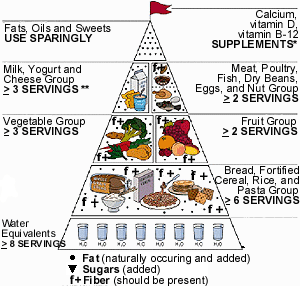
Modified Food Pyramid for 70+ Adults
These symbols show fat, added sugars, and fiber in foods
*Not all individuals need supplements, consult your healthcare provider
**> Greater than or equal to
These symbols show fat, added sugars, and fiber in foods
*Not all individuals need supplements, consult your healthcare provider
**> Greater than or equal to
As we said before, the elderly do not take in as many calories (i.e., as much food) as they did when they were young. Because of this, they are not getting as much of some nutrients as they need. In our newly designed pyramid, we made the base somewhat narrower to reflect the fact that less food is being taken in but chose foods that are nutrient-dense, that is, contain many more nutrients per gram of food eaten. In the fruit and vegetable groups, for example, the emphasis is on dark, deeply colored fruits and vegetables, rather than the colorless white vegetables, such as potato. In the bread and cereal/pasta group, the emphasis is on fortified cereals, whole bran and whole wheat breads, rather than on white bread. The milk or dairy group, which is important for all ages, is also emphasized for the elderly, as long as these dairy products are low in fat.
This new food pyramid also emphasizes the need for fluids, since the thirst mechanism is less responsive in the elderly. At the base of the pyramid there are eight servings of water or water equivalents. In addition, at the top of the pyramid, there is, for the first time, a small flag for supplements, particularly calcium, vitamin D and vitamin B12, as we have discussed.
JM
Rob, I think we could summarize our discussion today by saying that recently, we have gained remarkable insights into the nutritional and physiological changes that occur as we age. We know that most elderly people can benefit from strength training. Many need to adjust their diet or take supplements in order to maintain adequate levels of vitamins D and B12 along with calcium, folates and possibly vitamin E. On the other hand, they should be careful not to overdo the vitamin A and beta carotene. We can expect further news on this front in the coming few years.