


Table 1.
Deaths in U.S. in 1990 Per 100,000 Population
| CAUSE OF DEATH | RATE | % OF ALL DEATHS |
|---|---|---|
| Cardiovascular | 355 | 41 |
| Cancer | 203 | 23 |
| Lung Disease/Pneumonia | 67 | 8 |
| Accidents | 37 | 4 |
| Diabetes | 19 | 2 |
| Suicide | 12 | 1.4 |
| AIDS | 10 | 1.2 |
| Renal Disease | 8 | 1.0 |
CDC Monthly Vital Statistics Report: 1993;41,7 Supplement 1-12.
What Causes a Heart Attack?
Heart attacks generally occur in people who already have deposits of fat (lipids) attached to the walls of their coronary arteries (vessels supplying blood to the heart muscle). When these deposits (atheromatous plaques) somehow become disrupted and release lipid into the circulation, blood platelets, which are part of the body's clotting system, are activated. Clots form at the site of the disrupted plaque and a blockage of a coronary artery can occur.
Figure 1.
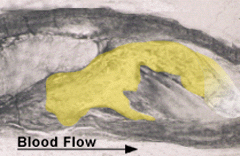
Representation of a coronary artery (longitudinal section) showing plaque (in yellow) which has pushed into the arterial lumen, narrowing it and thereby reducing blood flow downstream
If the coronary artery is completely blocked, the heart tissue that receives oxygen and nutrients via the artery ceases to function within seconds after a blockage. Irreversible heart tissue death (what we call a heart attack and what doctors call a myocardial infarction) is, however, delayed for approximately 20-30 minutes. Over the next three to twelve hours, more irreversible damage occurs. The extent of the damage depends on how much blood flow can reach the deprived heart tissue via naturally occurring bypass (collateral) circulation.
Clot Busting Therapy
Much clinical experience has shown the benefits of prompt restoration of coronary artery blood flow in patients with acute myocardial infarction. The I.V. administration of clot destroying medicines (thrombolytics) markedly reduces death in heart attack patients. And the earlier the treatment, the better. Patients treated within 90 minutes after onset of chest pain are one-seventh as likely to die compared to those patients who receive therapy after 90 minutes.
The quality of restored blood flow is also very important. It can't be just a trickle. It has to be sufficient to allow the heart to pump efficiently and effectively. Once a clot has been dissolved and the blockage cleared away, it is important to keep the artery open. Otherwise, mortality worsens, at an accelerated rate, in patients whose arteries close again during the following year.
How to Recognize a Heart Attack
The most common symptom is chest pain. It may feel like pressure under the sternum (breastbone) or sometimes a squeezing or burning sensation. The pain can be confused with heartburn. Occasionally, the pain starts in the arm or neck and travels to the other arm or the neck. Associated symptoms may include nausea, shortness of breath and heavy sweating. Most significantly, the symptoms don't improve with either nitroglycerine tablets or antacids. If you experience severe heartburn (without chest pain), see a doctor and have an electrocardiogram (ECG). Heartburn is the most common symptom in patients whose diagnosis of myocardial infarction is missed.
If you are having a heart attack, the doctor will probably find that your heartbeat is rapid (tachycardia) and that your blood pressure is elevated. With the stethoscope, the doctor may hear changes in your heart sounds and, possibly, noisy airflow (rales) in your lungs. The rales may be a sign that the heart is severely damaged, in so-called heart failure, unable to perform efficiently. In this situation, the patient often requires aggressive interventional therapy to help the heart pump more effectively, such as catheterization, emergency re-opening of the blocked coronary artery (angioplasty) or bypass surgery.
The key diagnostic test for patients with chest pain is a 12-lead electrocardiogram (ECG or EKG). While some patients will not have significant ECG findings, for those that do the diagnosis of acute myocardial infarction is virtually certain. New blood tests, which measure the level of certain enzyme markers (CK isoforms, troponin T and I, myoglobin) that rise with heart tissue damage, also help the doctor quickly diagnose a heart attack. This is important because the sooner the doctor is certain that a patient is having a heart attack, the sooner the patient can be given thrombolytic therapy to dissolve the clot and reopen the coronary artery.
There are other conditions that might cause some of the same symptoms as a heart attack. Pericarditis, an infection of the outside lining of the heart, is typically associated with chest wall pain that is worse when you lie down and improves when you sit up and lean forward. Other possibilities are pulmonary embolization, caused by large blood clots blocking the blood vessels supplying the lung tissue, and aortic dissection, a tear in the lining of the body's main artery, the aorta.
What Treatment Is Best?
In terms of thrombolytics, medicines that dissolve clots, we know that tissue plasminogen activator (t-PA) opens up the coronary artery more frequently, and earlier, in patients than does intravenous streptokinase. Although t-PA seems to be a good thrombolytic, in certain patients it is also associated with an increased risk of intracranial bleeding and strokes. Newer, third generation thrombolytic agents have been developed and have entered clinical practice. One of the newer medicines, recombinant plasminogen activator [r reteplase (r-PA)] can be given in two simple IV shots 30 minutes apart, which is easier than the other drugs which require infusions over 60 to 90 minutes.
Angioplasty vs. Thrombolysis
In angioplasty, the cardiologist threads a catheter, often attached to an inflatable balloon, into the blocked coronary artery and stretches open the fatty deposits, thus restoring blood flow to the heart tissue supplied by the artery. During the procedure, a stent, a wire mesh tubular support, may be inserted to keep open the coronary artery's damaged walls. For patients with massive heart attacks that have affected the muscles of the front of the heart and whose hearts are not pumping effectively (heart failure), data indicate that angioplasty is preferable to treatment with thrombolytics.
Summary
Key features for the treatment of acute myocardial infarction include early recognition of the condition by both the patient and the treating institution. Call 911 immediately (in the USA) when symptoms of chest pain develop. Some day soon, hopefully, administration of thrombolytics may routinely occur in the field, given the favorable results achieved in Europe and Israel, as well as the USA, with this form of therapy.