


Part of the problem is that it defies exact definition. Frailty is not really a disease but rather a combination of the natural aging process and a variety of medical problems. It is a little like the classic definition of pornography — experts may disagree on exactly what it is but most people know frailty when they see it.
Recently, however, gerontologists (doctors who specialize in the elderly) have been putting a new focus on frailty, beginning with a more precise definition.1 Gerontologists suggest that if someone has three or more of five factors, then that person should be considered frail. These factors are:Frailty may not be a disease, but there is no question that certain diseases and medical problems play a large role in it.
Using this definition, researchers studied a group of fairly healthy elderly people who were living in the community, that is, people who were not in a hospital or a nursing home. They found that 6.9% of these elderly were frail. They also found that frailty was a reliable predictor of a general decline in health. The frail faced an immediate future of falls, deteriorating mobility, disability, hospitalization and death. Frailty was also highly associated with with cardiovascular disease, low education and poverty.
How a Person Becomes Frail
The definition above, which is known as the Fried framework after its author, Dr. Linda Fried, has made it easier to identify frailty and to understand the complex interaction between physiological factors, external factors and aging that causes it. By the Fried definition, frailty is not a disease but rather a sort of intermediate state — between being functional and nonfunctional, and between being healthy and being sick.
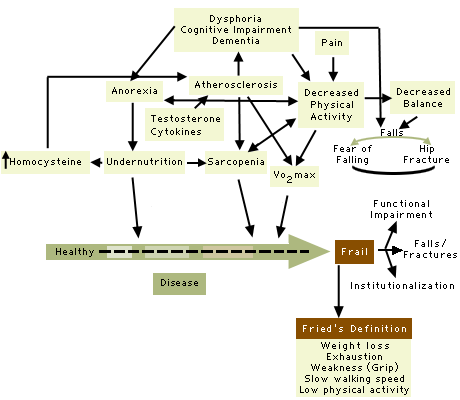
Frailty may not be a disease, but there is no question that certain diseases and medical problems play a large role in it, which other researchers believe also need to be considered. These include:
Anorexia
It is well recognized that older persons often develop anorexia, loss of appetite, as a natural part of the aging process. Add this to eating problems caused by certain diseases and the result is chronic undernutrition and, eventually, fatigue, weakness, cachexia (general wasting away) and micronutrient (vitamins and minerals) deficiencies. Hormone problems such as testosterone deficiency can aggravate anorexia.
Sarcopenia
Sarcopenia is defined as an excessive loss of muscle associated with aging. While genetically predetermined to some extent, several factors can accelerate the process. They include, among others, decreased physical activity, and testosterone and growth hormone deficiencies.
Immobility
Immobility can be caused by illnesses such as arthritis, which decreases the ability to move a joint, or by pain. Illness can also cause fatigue. Osteoporosis can set the stage for hip fracture which initiates a cycle of immobility whose endpoint is frailty.
Atherosclerosis
Atherosclerosis, or clogging of the arteries, produces frailty as less oxygen ("VO2") reaches the tissues and organs. Clogging of the arteries can also cause small strokes, which, in turn, can lead to cognitive impairment. In the legs, vascular disease caused by atherosclerosis can result in nutrient deprivation of the muscles, slowed walking speed and, ultimately, sarcopenia.
Balance Impairment
Balance deteriorates naturally over a person's lifetime. Decreased balance can initiate a vicious cycle in which accidental falls lead to a fear of falling, which leads to decreased mobility, which makes frailty worse. The good news is that animal studies have shown that exercise, such as those associated with Tai Chi, the ancient Chinese exercise form, can reverse the cycle, restoring balance.
Depression
Depression can result in a reduction in mobility and a pervasive feeling of fatigue. Depression also produces a slowing of thought processes. Depressed people are more likely to develop major illnesses, such as myocardial infarction, and to have more difficult, slower recoveries. Depression is also a major cause of anorexia and weight loss in the elderly.
Cognitive Impairment
Cognitive impairment can lead to a decline in mental processing time and reaction speed, resulting in an more frequent falls.
Figure 1.
Causes of Frailty
Can Frailty Be Treated or Prevented?
While some aspects of frailty are age-related and irreversible, others are not. Frailty should be seen as treatable, and as an important stage on the road to disability and serious illness.
Doctors should try to recognize frailty early and institute appropriate therapies. This alone would greatly enhance the quality of life of many older persons. On the other hand, many frail persons will suffer some kind of a physical illness or emotional upset; statistically, a fairly large percentage of those who meet the definition will die within five years. With this in mind, it is important to consider which therapies make sense for a frail elderly person and which are unlikely to improve the quality of life or the dying process.
Some of the most important steps to prevent or postpone frailty are presented in Table 1 below.
Table 1.
Preventing Frailty
Food: maintain intake
Resistance exercises
Atherosclerosi: prevent
Isolation: avoid (i.e., go out and do things)
Limit pain
Tai Chi or other balance exercises
Yearly check for testosterone deficiency
Treating Those Who Are Already Frail
The best treatment for frailty will vary because frailty has different causes in different people. Obviously, the first step is to get the best treatment for any diseases that are causing or contributing to frailty.
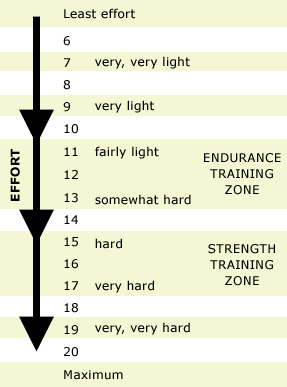
Any frail person should be given a test called the Geriatric Depression Scale. If they are depressed they should be treated. Resistance exercise is another cornerstone of the management of frailty. Unless they have a major cardiovascular problem, all frail persons should undergo resistance exercise training at least three times per week. Rate of Perceived Exertion (RPE) should be used to measure their progress and to design a proper program. If they have either muscle tears or arthritis, they should take a non-steroidal anti-inflammatory before exercising, as this improves long-term strength gain.
Table 2.
Rating of Perceived Exertion
All frail men should have their bioavailable testosterone measured; if it is low, these men should begin testosterone replacement therapy. The use of testosterone in women is controversial and should be discussed on an individual basis with your doctor. Growth hormone replacement has not been demonstrated to increase strength but does increase muscle mass and improve nitrogen retention.
Elderly people who are eating poorly should be encouraged to increase their food intake. Between-meal supplements may be helpful. There are also drugs called orexigenic agents, including dranabinol, marinol, and tetrahydrocannabinol, that can increase appetite.
Frail elderly people should be checked for hypothyroidism. Some may benefit from taking folate, vitamin B12 and vitamin B6 supplements. Vascular disease can be treated with drugs, as well as with aerobic and resistance exercises.
Early cognitive impairment may respond to a class of drug called cholinesterase inhibitors. Balance and flexibility exercises should also be part of any good aerobic or any good strength training program. Tai Chi, an ancient Chinese exercise form, is also an excellent set of exercises to improve balance and reduce falls.
Conclusion
Frailty has always been with us, though today it is increasingly seen not as an inevitable part of aging but as a condition that in many cases can and should be treated aggressively. Many of the causes of frailty, such as depression, vascular disease and vitamin deficiency, are treatable and even reversible through a combination of appropriate medical treatment, maintenance of a good diet and a good exercise regime.ADVERTISEMENT