



But there are two pieces of good news. First, with the greater use of mammography and diagnostic techniques that permit diagnosis at earlier stages, the cure rate is improving. Second, the one in eight risk isn't as high as it seems. It's a lifetime risk, what we call cumulative risk, based on a woman living to the ripe old age of 110. A woman's risk at age 50, for example, is much lower, 1 in 50. (see Table 1)
Table 1.
A Woman's Risk of Developing Breast Cancer by Age
| By age 25 | one in 19,608 |
| By age 30 | one in 2,525 |
| By age 35 | one in 622 |
| By age 40 | one in 217 |
| By age 45 | one in 93 |
| By age 50 | one in 50 |
| By age 55 | one in 33 |
| By age 60 | one in 24 |
| By age 65 | one in 17 |
| By age 70 | one in 14 |
| By age 75 | one in 11 |
| By age 80 | one in 10 |
| By age 85 | one in 9 |
| Ever | one in 8 |
source: NCI Surveillance Program
Two Kinds of Inheritance
Most cases of breast cancer, about 90%, result from one or more mutations, mistakes made while the cells are dividing in the breast tissue. We're not sure what causes these body cell ("somatic") changes — what you eat, where you live, passing cosmic rays have all been suggested as culprits.
Another 10% of breast cancer is associated with specific inherited mutations. So far, we've identified two genes, the BRCA1 or the BRCA2, which are passed from generation to generation with mutations for breast cancer already in them. A practical consideration from this knowledge is that a woman with a BRCA1 gene mutation in her family, who tests negative for that mutation, is not without risk for breast cancer. She still faces the one in eight lifetime risk for a somatic mutation and should continue surveillance accordingly.
Both BRCA1 and BRCA2 mutations confer increased risk for breast and ovarian cancer as well as for other cancers. They are tumor suppressor genes — when mutations alter or inactivate this function, cancer is more likely to develop. These genes were discovered through studies of families with multiple cases of breast cancer in different generations. Table 2 summarizes key information about the effect of mutations in these two genes.
Table 2:
Effects of Mutations in BRCA1 and BRCA2
| BRCA1 | BRCA2 | Bkgrd Risk | |
|---|---|---|---|
| Chromosome | 17 | 13 | |
| Year Discovered | 1990 | 1994 | |
| Year Isolated | 1994 | 1995 | |
| Mutations | 100 | 100 | |
| Breast cancer | 56-85% | 56-85% | 10-12% |
| Ovarian cancer | 26-85% | < 10% | 1% |
| Male Breast cancer | no | yes | |
| Other cancers | prostate | colon |
For a long time, many of us thought that breast cancer susceptibility was inherited through the maternal relatives. This is not the case with the mutations of the BRCA genes in women. These mutated genes can be inherited from either parent. Cases of breast and ovarian cancer may seem to skip a generation, when being carried by a male, but may well appear in females in the next generation.4 Remember, breast cancer can occur in men, usually associated with a mutation of BRCA2.
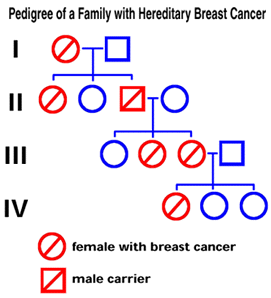
Figure 1. Four-generation pedigree showing autosomal dominant inheritance of a breast cancer gene. Breast cancer occurs in females in four generations. Note that the male carrier in Generation II has two daughters and a granddaughter with breast cancer.
Remember that the gene is one complex area on a single chromosome and within that gene are multiple spots where alterations (mutations) can occur, over 200 in the BRCA1 and BRCA2 genes combined.
In a single family, a specific mutation occurs. For example, among Jewish women of Eastern European origin, Ashkenazi, one study found the same pinpoint mutation in 21% of the Ashkenazi women who developed breast cancer before the age of 35. Ninety percent of Jews in the United States are Ashkenazi and over 2% of this group carry either BRCA1 or BRCA2 mutations.
What Do All These Many Mutations Mean?
Not all mutations result in the occurrence of breast cancer. Some mutations are in silent areas of the gene and are never expressed. Some mutations cause the cancer in one family member but not in another with the same mutation ("variable penetrance"). A recent study demonstrated a 56% risk of breast cancer in BRCA1 and BRCA2 mutation carriers.
How do these mutations, this inherited susceptibility, interact with other identified risk factors for breast cancer? We know, for example, that estrogen, whether manufactured by your body or taken by prescription, is a primary risk factor. How much of a contribution does an outside factor like estrogen make to the expression of the mutated gene? Would controlling this exposure protect a woman with a mutation? Remember that even a woman without that mutation still has a lifetime background risk for breast cancer of one in eight.
Weighing the Cost of Testing Against the Possible Benefit of Diagnosis
There are already over 200 mutations identified on BRCA1 and BRCA2. When genetic testing is first done on material from a member of a high-risk family, the entire BRCA1 and BRCA2 genes may have to be examined to determine which one of the many mutations is present. This could cost $2500 or more. If a specific mutation is identified, then other family members can be tested for a considerably lower cost (less than $500) because the precise area to be analyzed is known. Such testing is not typically covered by health insurance policies.
The Importance of Counseling
Far more important than cost is consideration of what the information from testing might mean and what effect it might have on a woman and on her family. Genetic testing of this sort is still in the research phase. Therefore, all physicians and health care professionals need to provide pretest and post-test counseling about what the potential results could be and what they mean, as well as support and follow-up for dealing with this knowledge. Expert counseling is crucial whenever genetic testing is undertaken.
When to Consider Testing
What are the family characteristics that would raise suspicion that you might have a mutation in a susceptible gene and so be a candidate for genetic testing? Here is a list of preliminary questions:
- Have you or a relative been diagnosed with breast or ovarian cancer at an early age?
- Has a relative, regardless of age, been diagnosed with breast AND ovarian cancer?
- Do you have any male relative with breast cancer?
- Do you have two or more relatives with breast or ovarian cancer?
The closer the relationship with these relatives, the higher the probability that you might have a mutation. This is especially true for first degree relatives (parent, sibling, or child). One note of caution — even if you test negative against a panel of known mutations on a particular gene and don't have the bad mutation, you could still have a yet undiscovered mutation on that gene or on another gene that could increase your risk for cancer.
Help Yourself and Others — The Cooperative Family Registry
Not all cases of what looks like hereditary breast cancer are explained by the presence of the known mutations. For my patients at risk for developing breast cancer, I recommend that they join The Cooperative Family Registry for Breast Cancer Studies. The Registry is a program funded by the National Cancer Institute to create a databank of specimens from individuals with a family history (including personal history) of breast and/or ovarian cancer. These specimens, along with detailed health and life-style information about you and information about affected family members, will be available to researchers. Each participant is asked to complete a yearly follow-up questionnaire.
This program is not about testing individuals. All personal identifying information is separated from the databank information and specimens. Participants in the program will learn about research progress (which may be relevant to them) from bi-annual newsletter reports. Educational programs will also be offered to Registry participants, as will the most up-to-date recommendations on surveillance.
This Registry is available at centers all over the United States and international locations — currently, Australia and Canada. Each center can provide referral for genetic counseling and testing or for expert breast and ovarian cancer care. It is a very positive way for women with a family history of breast cancer who do not want to be tested or who test negative to make a contribution to scientific advancement in breast cancer genetics and also keep up-to-date on developments in the field, which may be personally beneficial.
Further Reading
My colleague, Dr. Anne Moore, who is a Professor of Clinical Medicine at Cornell University Medical College, Chair of the Hematology Section of the American Board of Internal Medicine and President of the New York Metropolitan Breast Cancer Group has authored a very useful book, The Patient's Guide to Breast Cancer Treatment.