



Dr. Bremner is a faculty member of the Departments of Diagnostic Radiology and Psychiatry, Yale University School of Medicine, Yale Psychiatric Institute, and National Center for PTSD-VA Connecticut Healthcare System.
The research reviewed in this article was supported by an NIH-sponsored General Clinical Research Center (GCRC) Clinical Associate Physician (CAP) Award and a VA Research Career Development Award to Dr. Bremner, and the National Center for PTSD Grant.
The research reviewed in this article was supported by an NIH-sponsored General Clinical Research Center (GCRC) Clinical Associate Physician (CAP) Award and a VA Research Career Development Award to Dr. Bremner, and the National Center for PTSD Grant.
Post-traumatic Stress Disorder (PTSD) is something of an invisible epidemic. The events underlying it are often mysterious and always unpleasant. It is certainly far more widespread than most people realize. For example, a prime cause of PTSD is childhood sexual abuse. About 16% of American women (about 40 million) are sexually abused (including rape, attempted rape, or other form of molestation) before they reach their 18th birthday.
Childhood abuse may be the most common cause of PTSD in American women, 10% of whom suffer from PTSD (compared to 5% for men) at some time in their lives, but many other types of psychological trauma can cause the disorder — car accidents, military combat, rape and assault. Symptoms of PTSD include intrusive memories, nightmares, flashbacks, increased vigilance, social impairment and problems with memory and concentration.
It's Not Just Psychological
While such symptoms are commonly understood to be psychological problems, some or all of them may well be related to the physical effects of extreme stress on the brain.
Recent studies have shown that victims of childhood abuse and combat veterans actually experience physical changes to the hippocampus, a part of the brain involved in learning and memory, as well as in the handling of stress. The hippocampus also works closely with the medial prefrontal cortex, an area of the brain that regulates our emotional response to fear and stress. PTSD sufferers often have impairments in one or both of these brain regions. Studies of children have found that these impairments can lead to problems with learning and academic achievement.
Other typical symptoms of PTSD in children, including fragmentation of memory, intrusive memories, flashbacks, dissociation (or the unconscious separation of some mental processes from the others, e.g., a mismatch between facial expression and thought or mood), and pathological ("sick") emotions, may also be related to impairment of the hippocampus. Damage to the hippocampus, which processes memory, may explain why victims of childhood abuse often seem to have incomplete or delayed recall of their abusive experiences.
A Disease of Memory
Memory problems play a large part in PTSD. PTSD patients report deficits in declarative memory (remembering facts or lists — see below), fragmentation of memory and dissociative amnesia (gaps in memory lasting from minutes to days that are not caused by ordinary forgetting).
Psychiatric Symptoms Associated with Childhood Abuse
PTSD
- Nightmares
- Flashbacks
- Memory and concentration problems
- Hyperarousal
- Hypervigilance
- Intrusive memories
- Avoidance
- Abnormal startle reponses
- Feeling worse when reminded of trauma
Dissociative
- Out-of-body experiences
- Derealization
- Amnesia
- Fragmented sense of self and identity
Anxiety
- Panic attacks
- Claustrophobia
Substance Abuse
- Alcoholism
- Drug addiction
Many abuse victims report that they remember seemingly random or minor details of the abuse event, while forgetting central events. For instance, one woman who had been locked in a closet had an isolated memory of the smell of old clothes and the sound of a clock ticking. Later, she connected these details with feelings of intense fear; only then was she able to recall the whole picture of what had happened to her. PTSD also causes problems with non-declarative memory (subconscious or motor memory, such as remembering how to ride a bicycle). This can show up as abnormal conditioned responses and the reliving of traumatic experiences when something happens to remind the sufferer of past abuse. These types of memory disturbance may also be related to physical changes in the hippocampus and medial prefrontal cortex.
How Psychological Trauma Affects the Hippocampus and Memory
Childhood abuse and other sources of extreme stress can have lasting effects on the parts of the brain that are involved in memory and emotion. The hippocampus, in particular, seems to be very sensitive to stress. Damage to the hippocampus from stress can not only cause problems in dealing with memories and other effects of past stressful experiences, it can also impair new learning. Exciting recent research has shown that the hippocampus has the capacity to regenerate nerve cells ("neurons") as part of its normal functioning, and that stress impairs that functioning by stopping or slowing down neuron regeneration.
We recently conducted a study to try to see if PTSD symptoms matched up with a measurable loss of neurons in the hippocampus. We first tested Vietnam combat veterans with declaratory memory problems caused by PTSD. Using brain imaging, these combat veterans were found to have an 8% reduction in right hippocampal volume (i.e., the size of the hippocampus), measured with magnetic resonance imaging (MRI), while no differences were found in other areas of the brain (Figure 1).
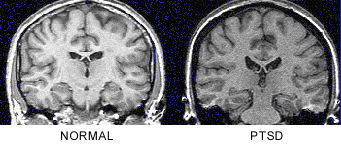
Our study showed that diminished right hippocampal volume in the PTSD patients was associated with short-term memory loss. Similar results were found when we looked at PTSD sufferers who were victims of childhood physical or sexual abuse.
More recent studies have since confirmed hippocampal volume reduction in PTSD These studies also show that hippocampal volume reduction is specific to PTSD and is not associated with disorders such as anxiety or panic disorders.
Further study on the question of memory and the hippocampus may some day shed light on the controversy surrounding delayed recall, or so-called "recovered memories" of childhood abuse. The hippocampus plays an important role in connecting and organizing different aspects of a memory and is thought to be responsible for locating the memory of an event in its proper time, place and context.
We suspect that damage to the hippocampus following exposure to the stress brought on by childhood abuse leads to distortion and fragmentation of memories. For instance, in the case of the PTSD sufferer who was locked in a closet as a child, she had a memory of the smell of old clothes but other parts of her memory of the experience, such as a visual memory of being in the closet or a memory of the feeling of fear, are difficult to retrieve or completely lost. In cases like this, psychotherapy or an event that triggers similar emotions may help the patient restore associations and bring all aspects of the memory together.
This new understanding of the way childhood trauma affects memory and the brain has important implications for public health policy. One example would be the case of inner-city children who have witnessed violent crimes in their neighborhoods and families. If this kind of stress can cause damage to brain areas involved in learning and memory, it would put these children at a serious academic disadvantage in ways and for reasons that programs such as Head Start may be unable to address. Studies confirm this: in war-torn Beirut, traumatized adolescents with PTSD, as compared to non-traumatized adolescents who were without PTSD, lagged behind in academic achievement.
PTSD and Other Brain Areas
Besides the hippocampus, abnormalities of other brain areas, including medial prefrontal cortex, are also associated with PTSD.
The medial prefrontal cortex regulates emotional and fear responses. The medial prefrontal cortex is closely linked to the hippocampus. In several studies we have found dysfunction of both the medial prefrontal cortex and the hippocampus at times when patients were suffering from PTSD symptoms.
We believe that dysfunction in these medial prefrontal regions may underlie pathological emotional responses in patients with PTSD. For example, we sometimes see a failure of extinction of fear responses — a rape victim who was raped in a dark alley will have fear reactions to dark places for years after the original event, even though there is no threat associated with a particular dark place. In a study using combat-related slides and sounds to provoke PTSD symptoms, combat veterans with PTSD had decreased blood flow in the area of the medial prefrontal cortex. Significantly, this did not occur in combat veterans without PTSD32 We saw similar results when we compared women with PTSD and a history of childhood sexual abuse to women with a history of abuse but no PTSD.
The good news is that treatments for PTSD result in an improvement in the brain. Treatment with paroxetine for up to a year in PTSD patients resulted in significant improvements in verbal declarative memory and a 4.6% increase in mean hippocampal volume. Studies have also shown an increase in right hippocampal and cerebral cortical brain volume with treatment with phenytoin in PTSD. Still other recent studies have also shown changes in the brain with psychotherapy for PTSD.
Conclusion
Traumatic stress, such as that caused by childhood sexual abuse, can have far-reaching effects on the brain and its functions. Recent studies indicate that extreme stress can cause measurable physical changes in the hippocampus and medial prefrontal cortex, two areas of the brain involved in memory and emotional response. These changes can, in turn, lead not only to classic PTSD symptoms, such as loss and distortion of memory of events surrounding the abuse, but also to ongoing problems with learning and remembering new information. These findings may help explain the controversial phenomenon of "recovered" or delayed memories. They also suggest that how we educate, rehabilitate and treat PTSD sufferers may need to be reconsidered.